Lead
One system, from the broker’s email to the policy.
We build the software that underwriting agencies run on. A broker sends in a risk; the same system prices it, issues the policy, handles the changes, takes the money and produces the report the insurer needs at month end.
A broker’s risk is not re-typed. The price is worked out the same way each time, and the system keeps a permanent record of what happened and why — so when someone asks, the answer is on file rather than in somebody’s memory.
I built a Lloyd’s coverholder in Australia from nothing to $100m GWP in a little over three years. The hardest part was not the underwriting — it was the year of building products, operations and compliance before we could write a policy. Cuttleflow is the system I wish I had been able to switch on from day one.
Where do you sit?
I underwrite
Agencies, MGAs and Lloyd’s coverholders. The system your book runs on — and, if you’re starting, the reason you don’t have to build it first.
I provide capacity
What your coverholder can actually show you when you ask how they control the pen.
I run a mutual
Discretionary mutuals and mutual managers. Member records, renewal seasons, contributions and board-decided claims in one system.
What the system is built to do
A new product in weeks, not months
The wording, the questions, the prices and the rules are all settings someone fills in, not software written from scratch each time.
Questions · Eligibility · Rating · Underwriting authority · Policy wording · Documents · Taxes and levies · Referral rules · Reporting
The same answer every time
Put the same risk in twice and you get the same price twice — today, or in three years when somebody queries it. Artificial intelligence helps read the paperwork. It never decides the price.
A record that can’t be changed after the fact
Every step is written down at the time, and nothing is painted over: a correction sits next to what it corrected — the record an auditor can check.
Starting an agency
Getting to market →The expensive year before the underwriting starts paying.
A new agency or Lloyd’s coverholder normally funds a rating tool, a policy system, documents, taxes and levies, bordereau tooling and a compliance framework — plus the people to run them — before a single policy earns anything. Those fixed costs decide which agencies get to exist, and they have nothing to do with how good the underwriter is.
Start with one underwriter, one binder and one product — and run it properly from day one.
Here the machinery already exists. Your product is configuration on top of it, the cost follows the book rather than arriving a year ahead of it, and the delegated-authority evidence your capacity provider will ask for is produced as the work is done.
A demo you can drive, not a video.
Eight working rater demonstrations, one for each class of business. Put a risk in, move the limit, watch the premium build up line by line. Push it past an underwriter’s authority and watch it stop offering to bind and start offering to refer.
Submission in → data extracted → rules applied → premium built → referred or bound → policy issued → bordereau.
The raters are the fourth step. The product tour walks the whole line, from the broker’s email to the bordereau.
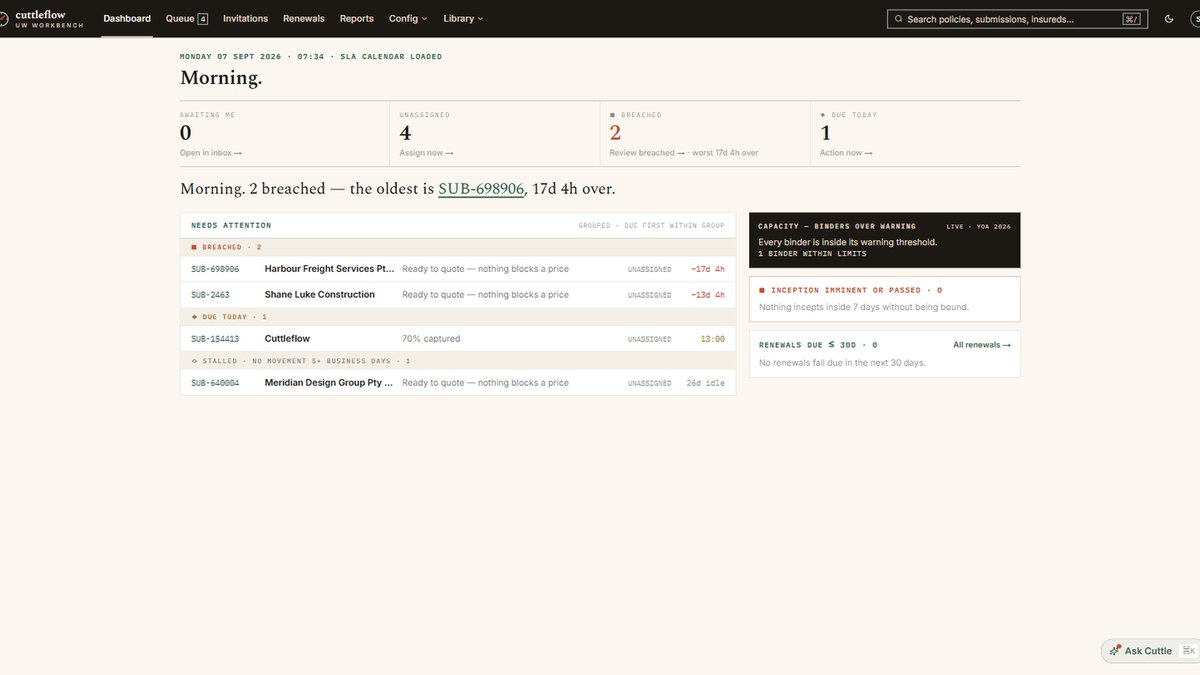
Or take the tour
One submission, start to finish. Then behind the counter.
Thirteen screens of the workbench, one control to click on each: a broker’s email becomes a rated, bound, bordereau-ready policy, then the product, the rater and the binder it ran on. Or watch the ninety-second recording, with its transcript.
Writing
All perspectives →The launch deck
Fourteen slides and the spoken notes from the Sydney launch, every source linked. Read the deck →
Wordings you don’t have to write from scratch
Reviewed base wordings, published openly — start from a working draft, not a blank page. The Commons →