One product, many countries
Cuttleflow Systems has designed a way for an insurer with offices in several countries, or an underwriting agency planning its second, to build a product once and launch it in each country without building it again. The product is built in its home country as a base product. Each country supplies a jurisdiction pack: its taxes, statutory schemes, documents, conduct rules, benefit conventions, language, currency and data region. A country office launches the product as that country’s variant, changes only what the group allows it to change, and signs it off locally. Each office sells through the channels it chooses, including direct to customers, and the group sees every country’s book in one currency.
This piece follows one insurer group through that work, using the screens of its global product division. The screens are from the Cuttleflow Marketplace demonstration, with a fictional insurer, offices, partners and figures.
Why a product is built again in each country
Building a product takes a long time even in one country. In interviews for a 2019 Deloitte study, insurers said it usually takes 12 to 18 months to create and roll out a new product, and three to six months to change an existing one (Deloitte, 2019). In a 2025 West Monroe survey, 54% of insurers said they spend more than half their IT budget keeping existing systems running, and 46% said even a minor product update takes nine to 16 weeks (PropertyCasualty360, 2025).
A group with offices in seven countries usually does this seven times. Each office runs its own system, with its own copy of the wording, rating, documents and reports. A change made in one country has to be made again in the others, and the group’s view of its book arrives late, in seven currencies.
Some of this local work cannot be removed, because each country regulates the products sold in it. In Australia the issuer of a retail product must make a target market determination under the design and distribution obligations (ASIC RG 274). In the European Union the product oversight and governance rules of the Insurance Distribution Directive apply to every insurance product (EIOPA, Q&A 2265). A group cannot simply copy a product into a new country. It can avoid building the parts that do not change.
Separate what is the same from what is local
The design starts by dividing a product into two parts.
The same in every country
- Sections, benefits and limits
- Questions and the rating structure
- Decline and referral rules, and underwriting authority
- Document templates
- Bordereau and reporting data
In the country’s pack
- Premium taxes and levies, dated by effective date
- Statutory schemes the product sits beside
- Regulatory documents and conduct rules for each channel
- Benefit conventions
- Language, currency, data region and the complaints route
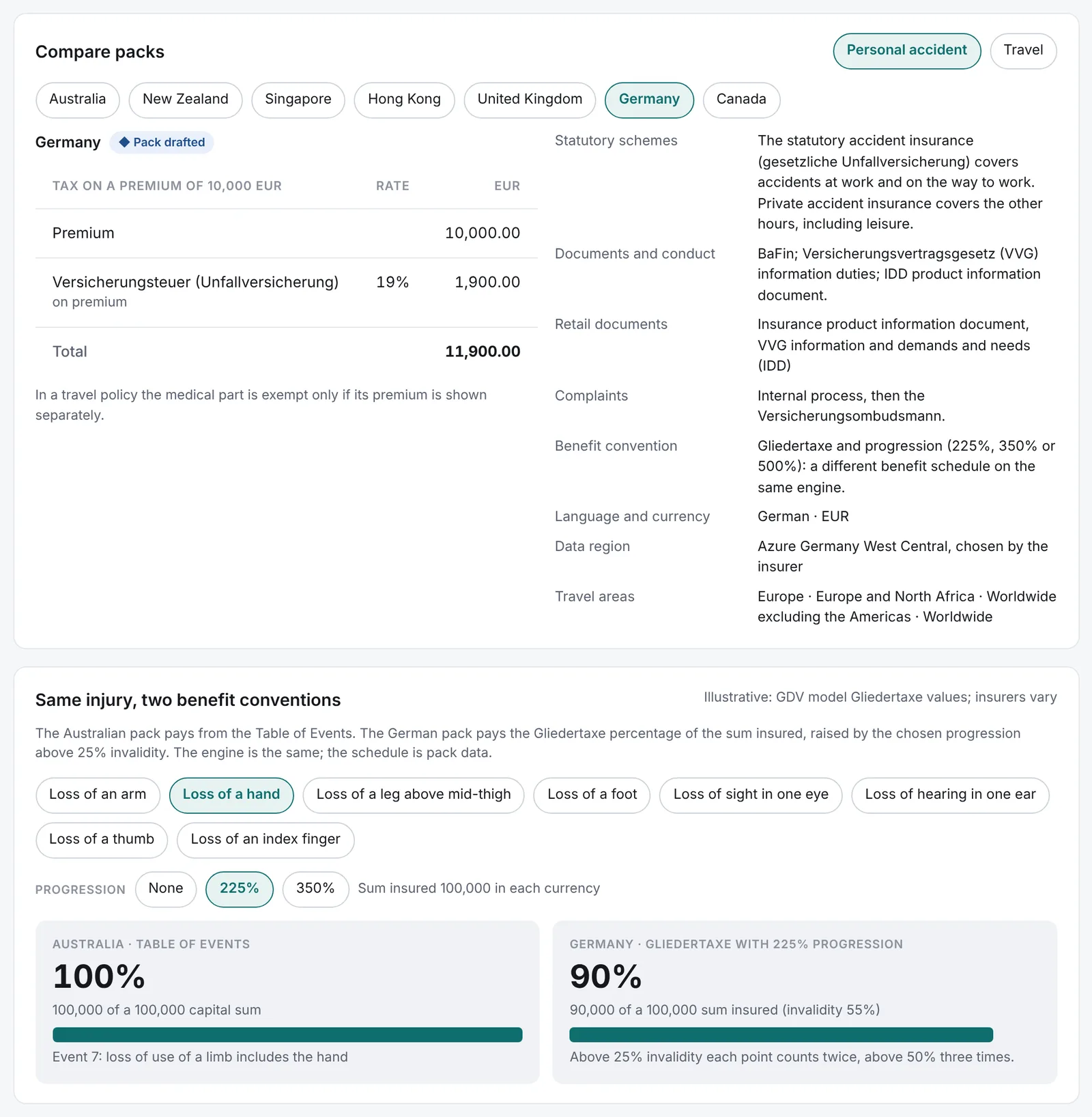
A pack is built once for each country and used by every product launched there. The second product launched in New Zealand needs no tax work, because the New Zealand pack already has it. Seven products in seven countries come from seven products and seven packs, not 49 separate builds.
Accident cover shows why benefit conventions belong in the pack. In Australia a personal accident policy pays from a table of events, such as 100% of the capital sum for loss of use of a limb. In Germany the market pays a percentage of the sum insured from the Gliedertaxe, raised by a progression above 25% invalidity. The rating and claims software is the same; the schedule it reads is pack data.
Build the base product once
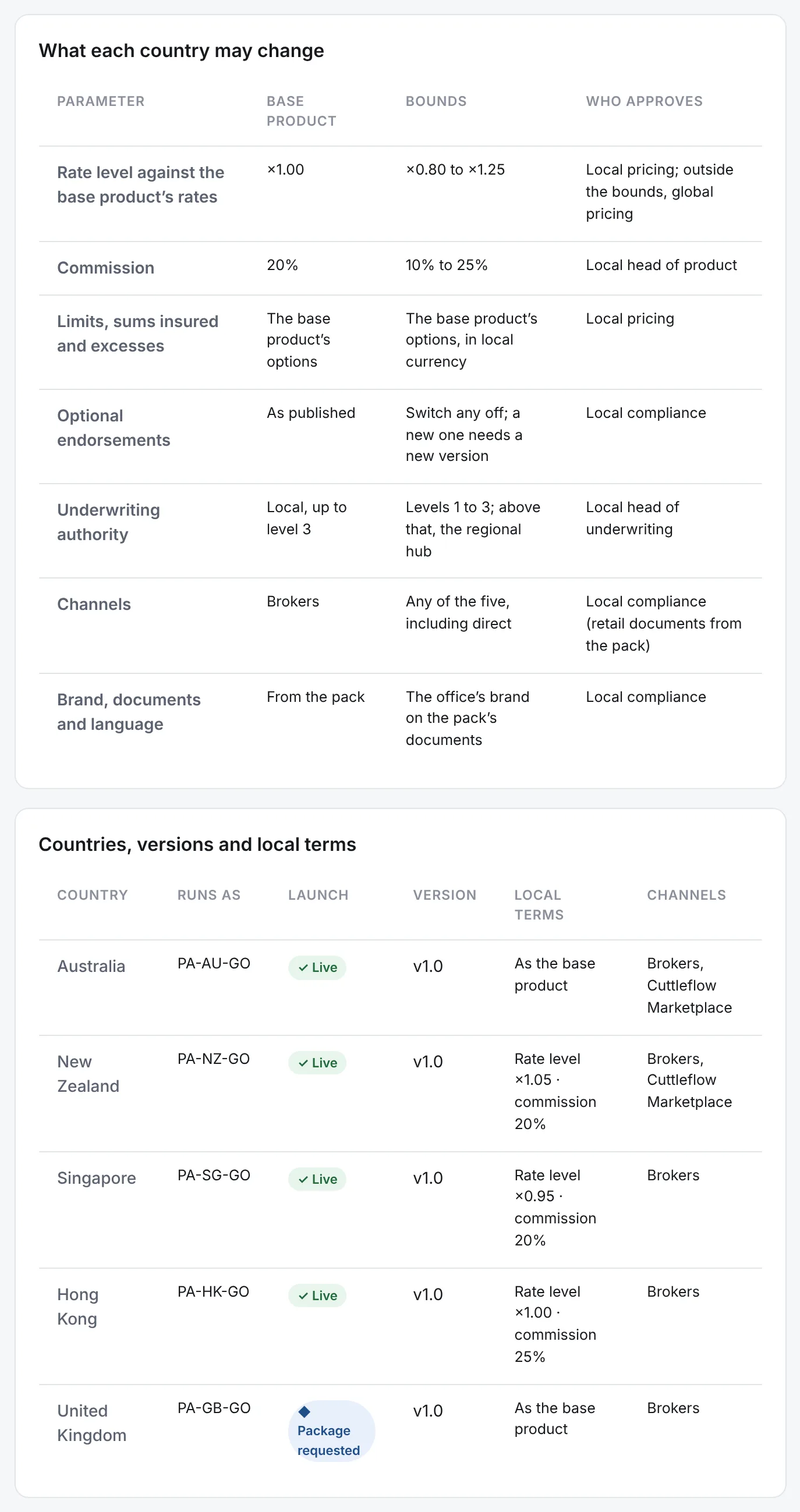
The group’s product team owns the base product. It decides what each country may change and how far: a rate level between ×0.80 and ×1.25 of the base rates, commission between 10% and 25%, which optional endorsements to switch off, what underwriting authority to delegate, and which channels to open. A country that goes outside a limit needs a sign-off from group pricing. The same screen shows which version each country runs and where an office has moved from the base product.
A change to the base product is made once and goes to every country. Countries still launching take the new version automatically. Each live country reviews it and accepts it when its office is ready.
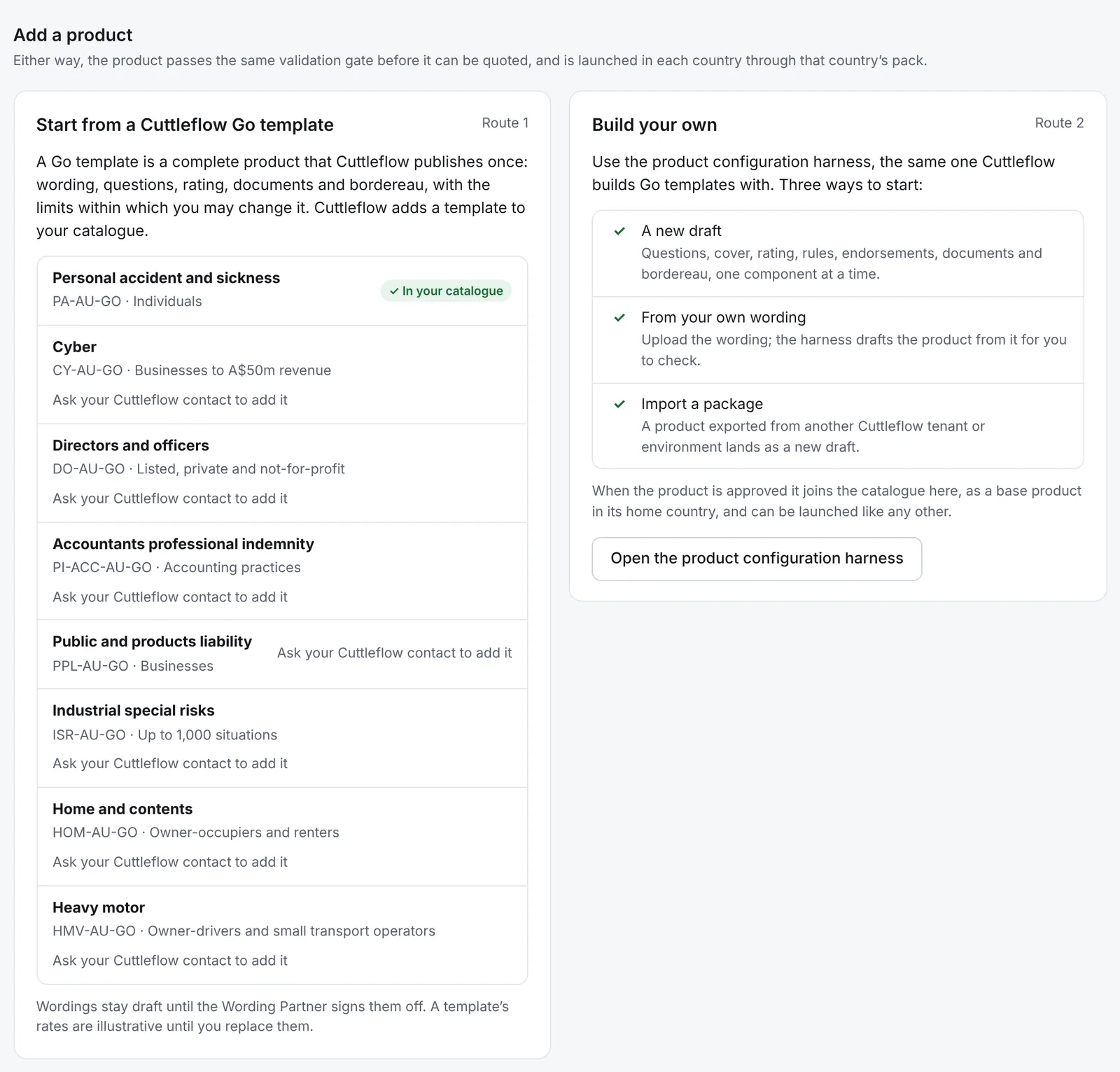
A group can start from a product it already has, or add one in two ways. It can start from a Cuttleflow Go template, a complete product that Cuttleflow publishes with its wording, questions, rating, documents and bordereau. Or it can build its own in the product configuration harness that Cuttleflow uses to build those templates: from a blank draft, from its own wording, or by importing a product package. Either way the product passes the same validation before it can be quoted.
Launch it in a country
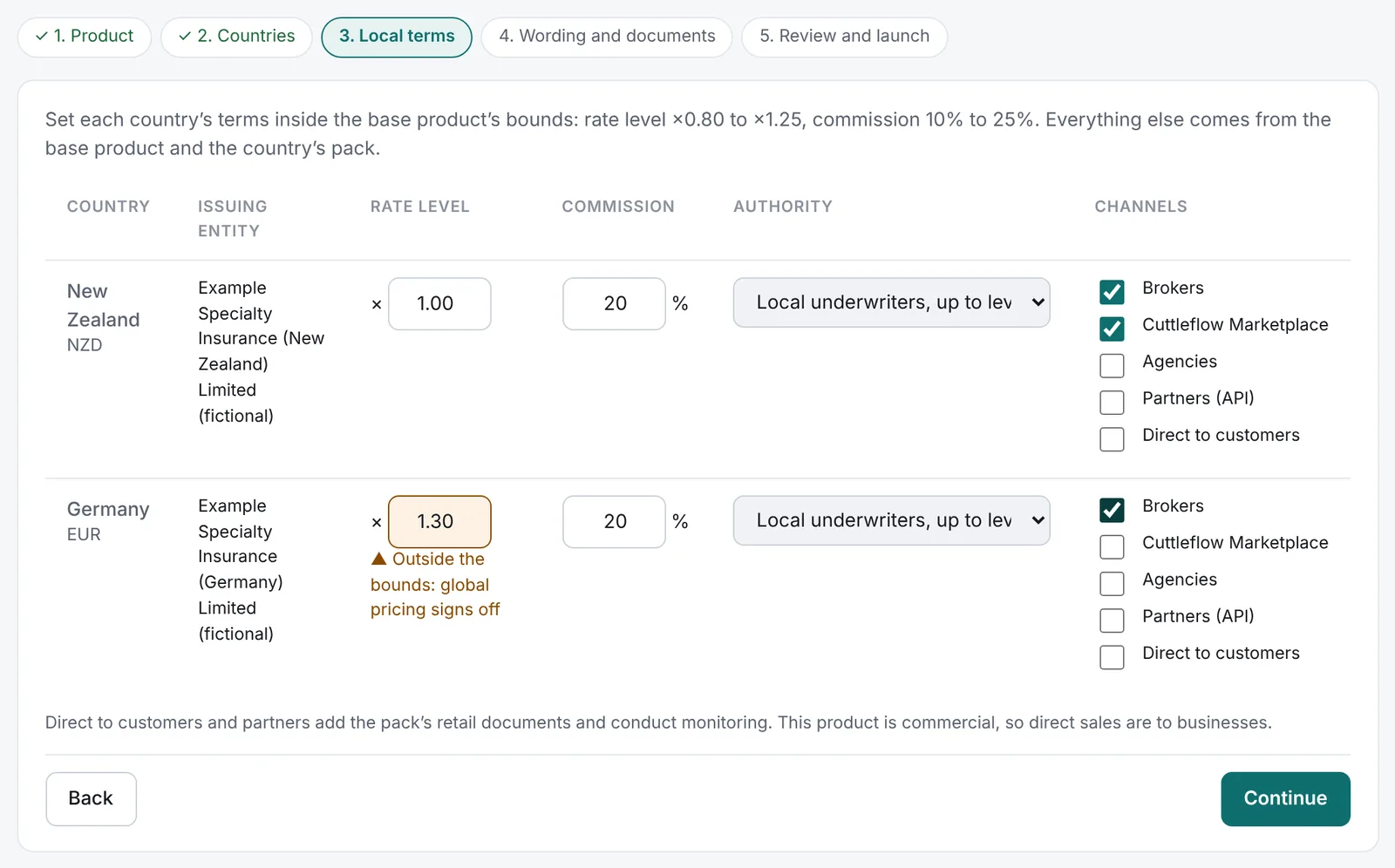
Launching is a short sequence that the insurer runs for its own countries. The product manager chooses the product and the countries, sets each country’s terms inside the limits, and chooses how the wording is deployed. A new country usually starts on its own local wording, on the same questions, rating and rules, because that is the quickest way to meet local law. A country can later move to the group’s wording with a country addendum.
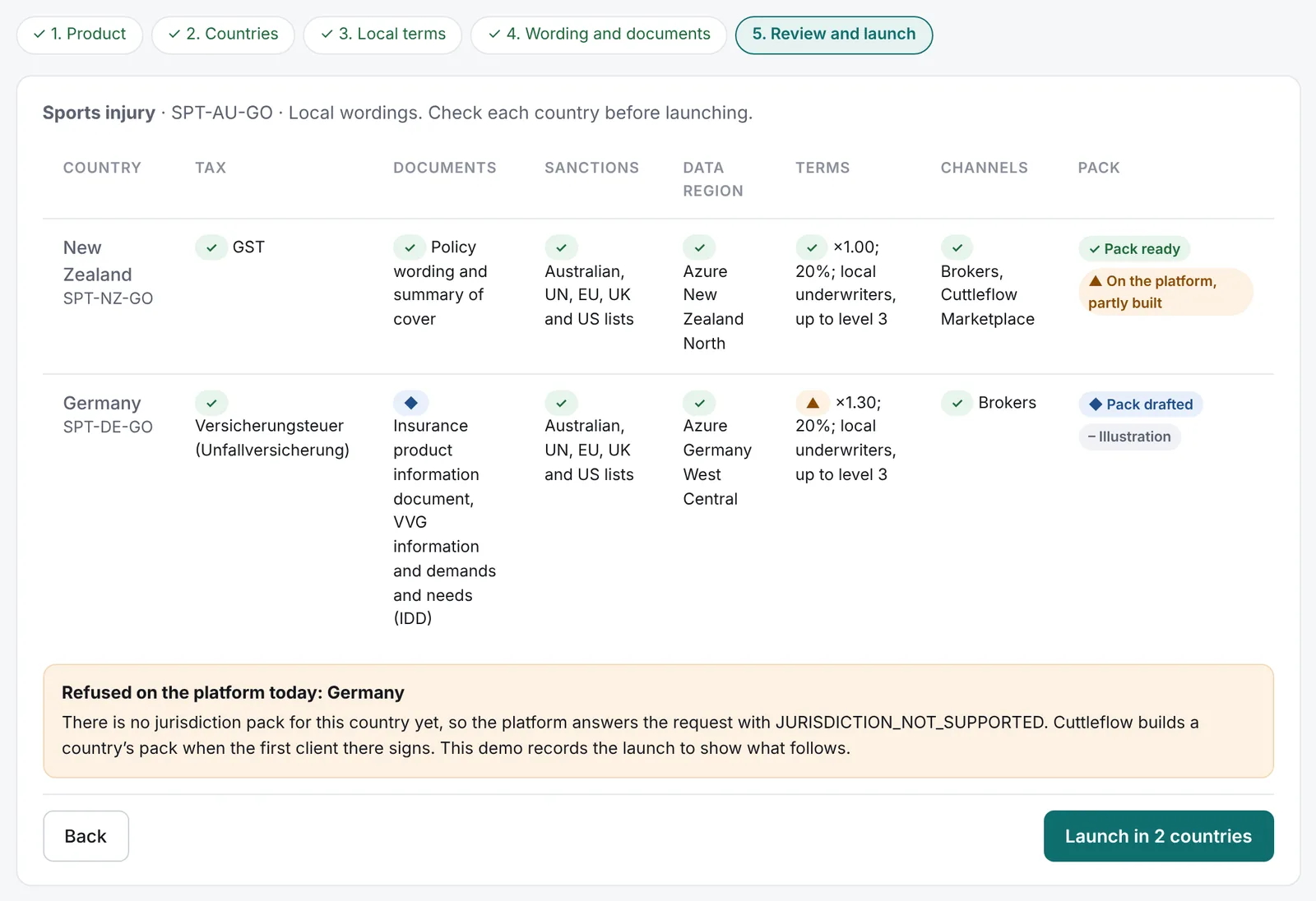
Before anything is launched, the review shows what each country’s pack supplies: taxes, documents, sanctions screening, data region, terms and channels. Where a country has no pack yet, the review says so, because a product cannot be priced or documented there without one.
Each launch then goes through the country’s own approval. Six sign-offs are recorded: local compliance, including the target market determination or its local equivalent; legal review of the wording; pricing; licence or fronting; tax set-up; and claims and assistance. Each sign-off names who approved it and the evidence it rests on. The product is approved only when all six are, and every move is written to the audit record before it happens.
Let each office choose its channels
Each country office decides how its variant reaches customers: through brokers, on the Cuttleflow Marketplace, through agencies under delegated authority, through partners by API, or direct. For accident and health and travel, direct and partner sales matter: the customer often buys on the office’s own website or during a booking. The office can sell under its own brand or a partner’s. The base product, rating and rules are the group’s; the pack supplies the local tax, documents and language.
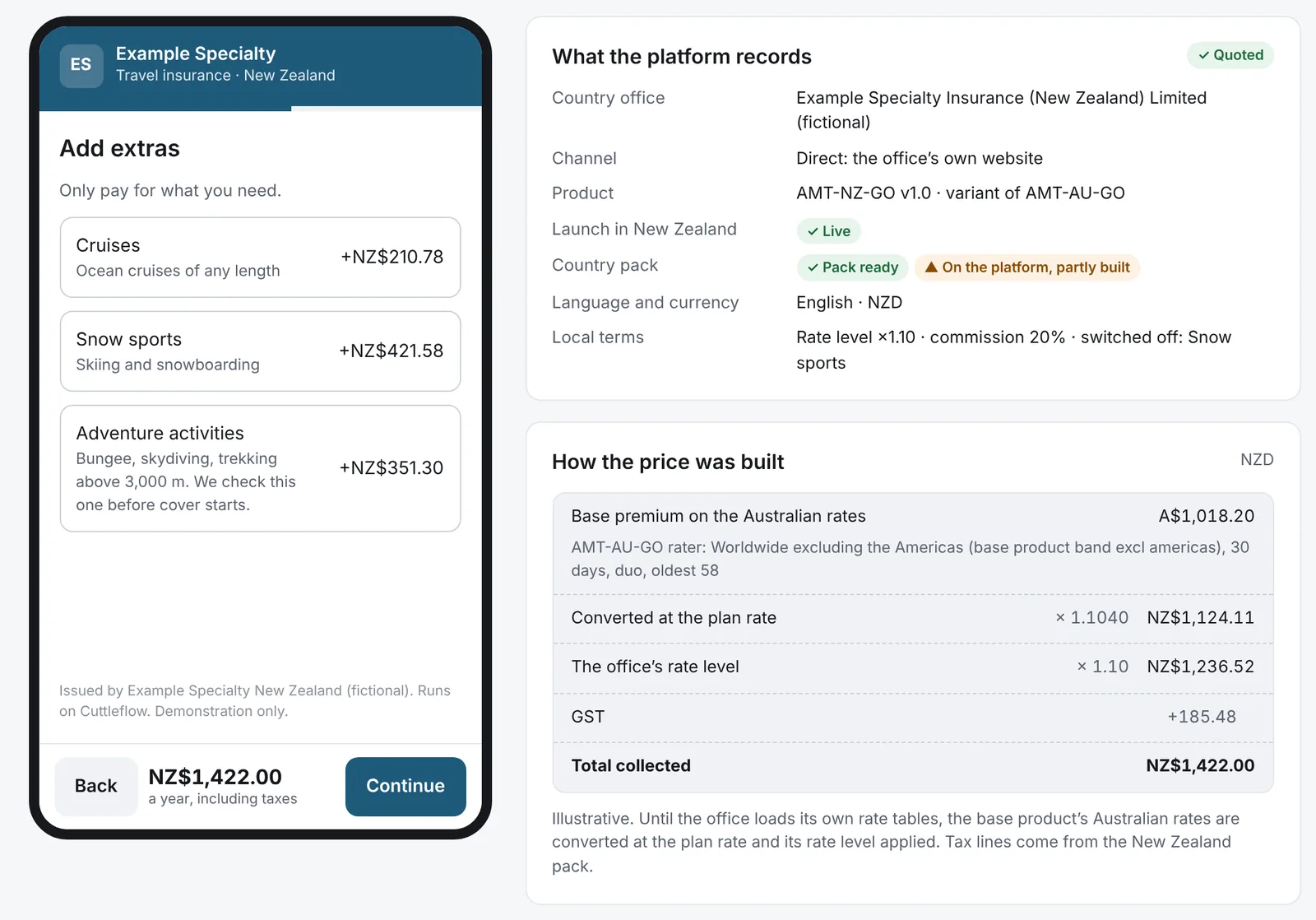
Every sale, whatever the channel or brand, is recorded against the country office, the channel and the variant, and lands in one bordereau.
See the whole book in one currency
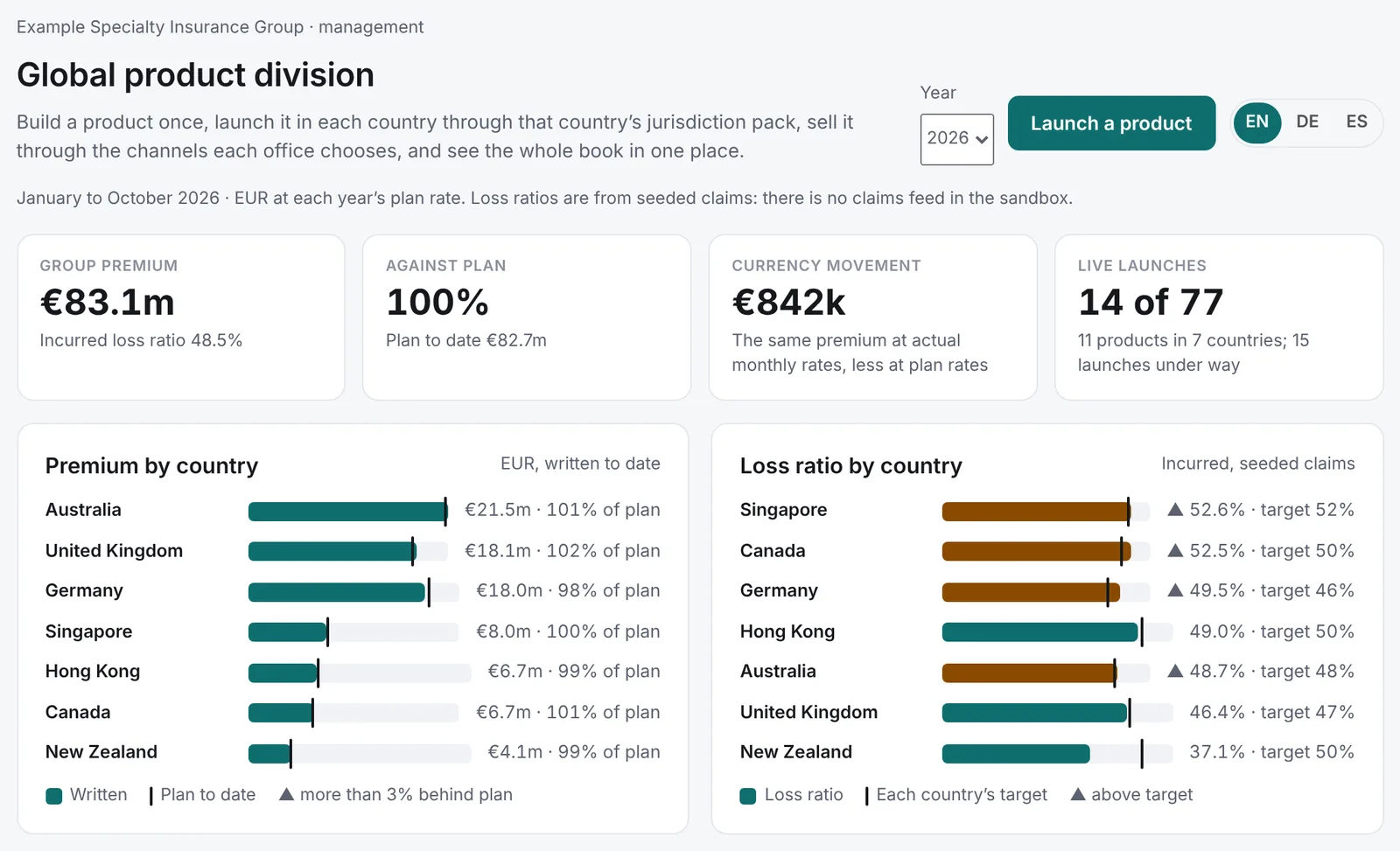
The group’s overview shows every country at once, in the reporting currency at the year’s plan rate, with currency movement shown separately so that a weaker currency is not read as weaker underwriting. It shows premium by country against plan, loss ratio against each country’s target, and premium by channel by month.
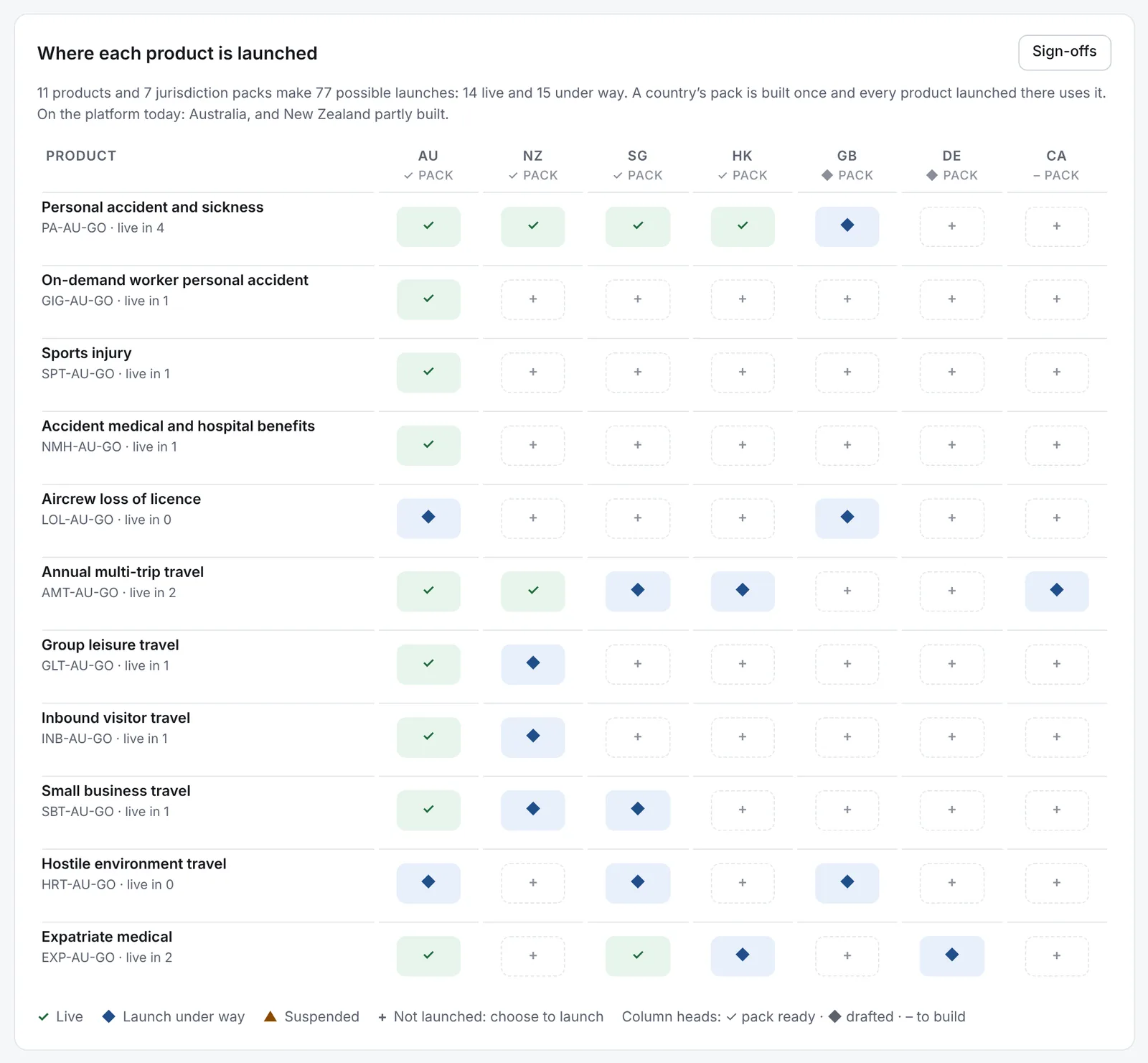
Below the figures, one grid shows every product in every country: live, launch under way, suspended, or not launched. A product manager starts a launch from an empty cell and opens the sign-offs from a filled one.
International programmes
The same structure supports a multinational programme. An Australian employer with staff in New Zealand, Singapore and the United Kingdom buys one group programme. Each country’s local policy is issued on that country’s pack, in its currency and with its tax, and a master policy in Australia covers the difference in conditions and limits. The insurer sees the programme in one portfolio view and one bordereau.
What an insurer group gets
- One build per product, not one per country.
- One build per country, shared by every product launched there.
- Local control inside group limits, with anything outside them sent to the group for sign-off.
- A change made once, accepted by each country when it is ready.
- Local approval on the record, with six named sign-offs and the evidence for each.
- Each office’s own channels, including direct and partner sales.
- One book, in one currency, with currency movement kept apart.
The objections
- “Our country offices will not give up control.” They keep the decisions that are theirs: local terms inside the limits, the wording deployment, their channels and brands, and the six sign-offs. They stop rebuilding what the group has already built.
- “Every country is different.” The differences are what the pack holds. The questions, rating structure, rules and reporting data are usually the same.
- “We have systems in every country already.” A country office can keep its own system for its existing book. The overview reports entities on their own systems alongside those on the platform, and a new product can launch on the platform first.
Where Cuttleflow sits
The global product division shown here is from a gated demonstration with a fictional insurer group. On the platform, the management screens for an insurer group (the overview, country portfolio, delegated authority, launch and sign-offs) are in development and tested on sandbox tenants. Jurisdiction packs on the platform today are Australia and, in part, New Zealand. Cuttleflow builds a country’s pack when the first client in that country signs, and until then the platform refuses a launch there. Building variants from the base product, enforcing each country’s limits, rolling versions out across countries and direct sales outside Australia are being built. The Cuttleflow Marketplace is not yet open for live business, and each class opens only when its conditions, including licensing advice, are met.
Sources
- Modernizing insurance product development, Michelle Canaan and Kelly Cusick, Deloitte Insights, 9 October 2019
- Legacy tech is starving innovation in the insurance industry, Joe Toppe, PropertyCasualty360, 28 October 2025, reporting a West Monroe survey of insurers
- Regulatory Guide 274: Product design and distribution obligations, Australian Securities and Investments Commission
- Q&A 2265: POG requirements in Article 25 IDD in relation to the size of the target market, European Insurance and Occupational Pensions Authority
This piece describes a software model in general terms. It is general information, not legal or tax advice. Screens shown are from a demonstration with a fictional insurer group, offices, partners and figures; taxes, schemes and benefit conventions are shown for illustration and should be checked for any real product. Cuttleflow Pty Limited trading as Cuttleflow Systems is a software provider. It does not hold an Australian financial services licence and does not issue, arrange or advise on insurance. Insurers, underwriters and brokers advise, quote and bind under their own licences.
Cuttleflow Systems · Perspective 31 · 33°53′S · 151°16′E · Sydney