From enquiry to client report
Cuttleflow Systems has designed a broker workflow that sits beside the broker’s existing broking management system and removes the administration around each placement: typing the same risk into several insurer portals, chasing quotes, and building each client’s report by hand. One client record runs from the first enquiry to the bound policy. Enquiries arrive with the client’s answers already in it. The broker sends the risk to every market that fits in one step, the quotes come back side by side, and the client report is assembled from the placement. Bound policies go to the broker’s own system for invoicing and the trust account. The broker’s time goes on advising clients and negotiating with markets, which is the work clients pay for.
The cost of the current way of working is well known. In a 2024 survey of 500 Australian brokers at small and medium firms, 70% said they spend more than three hours a day on administration, including processing data (JAVLN, 2024). In a US survey of more than 700 agents, re-keying data was the top workflow problem for 74%, and 54% said they lose commercial deals every month because they cannot reach the right markets fast enough (Ivans, 2026).
This piece follows one client from first enquiry to a bound policy and a client report, using the screens a broker works in. The screens are from the Cuttleflow Marketplace demonstration, with fictional clients, markets and figures.
Enquiries that arrive qualified
A lead is worth more when it arrives with enough to act on. Every channel in Cuttleflow’s client acquisition tools asks the business the questions an indicative price needs, and passes the answers to the broker with the lead.
- The broker’s own channels. Signed links in emails, newsletters, ads and QR codes open the broker’s page with the industry and covers filled in. The same lookup and price can sit on the broker’s website, and an AI assistant can find the covers a business needs and hand it to the broker’s page.
- Price My Risk. A business searches by what it does, sees the covers businesses like it usually consider and an indicative price, and asks to be referred to one broker who places its industry. It arrives having already described its risk and seen a price.
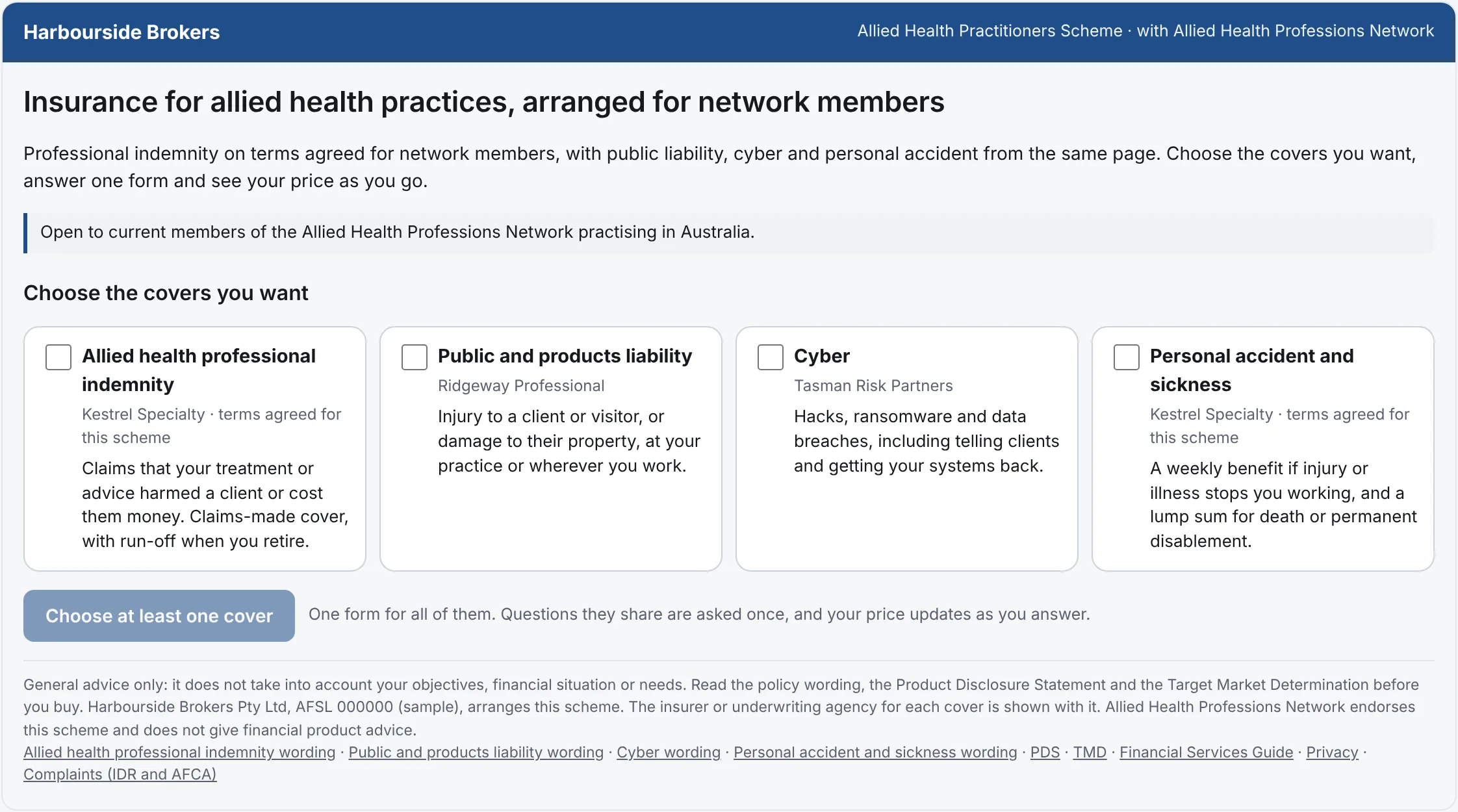
- Schemes. A broker builds a scheme for an association, profession or industry group from products agreed for that audience. Members confirm they are eligible, choose their covers on one form and see the price as they answer. Every member who reaches the broker fits the scheme.
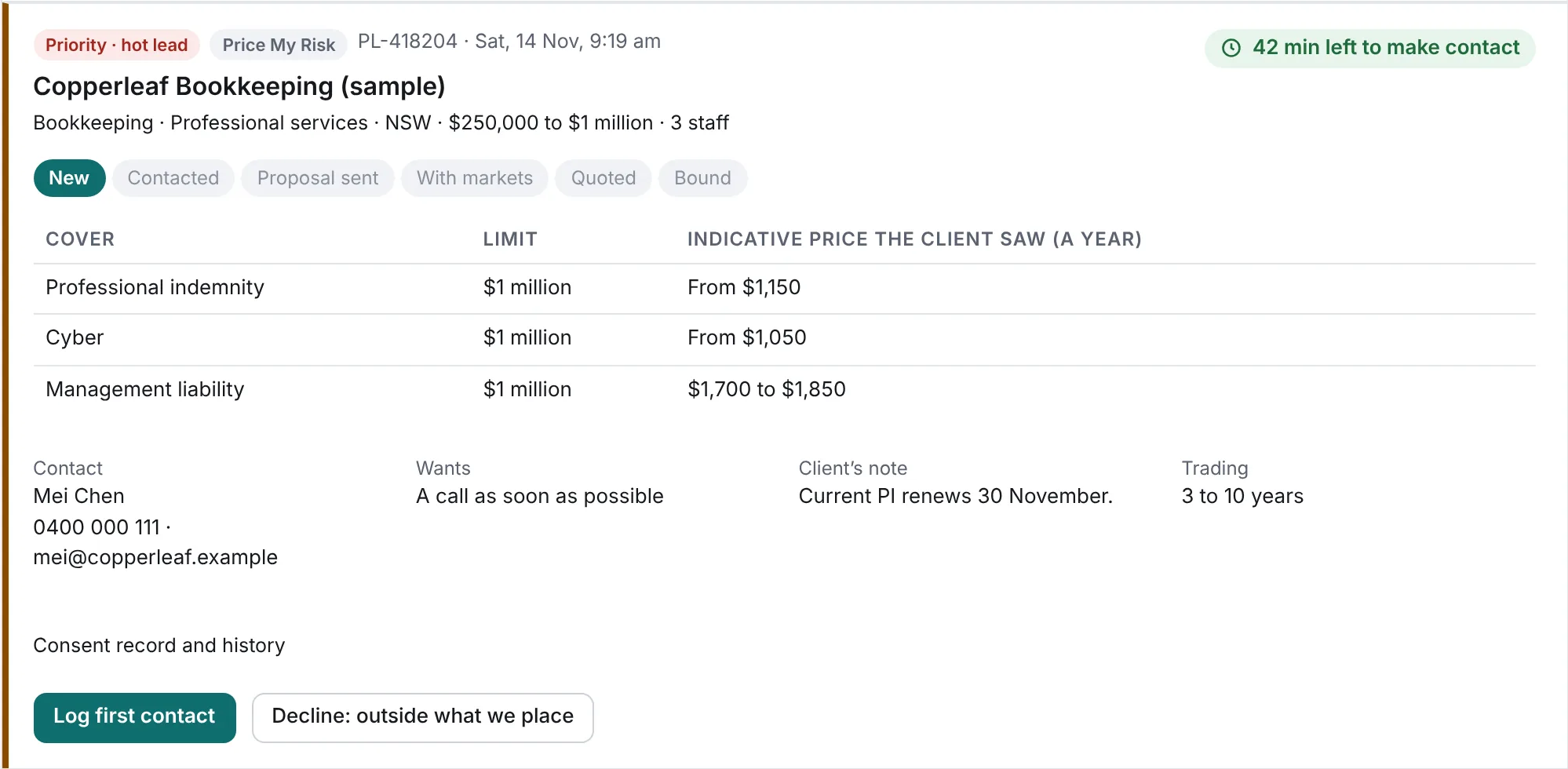
Each enquiry lands in Priority leads with the business’s answers, the price it saw, its consent and the time left to make first contact. From there it goes to markets as an ordinary submission, without being typed again.
The fact-find, done by the client
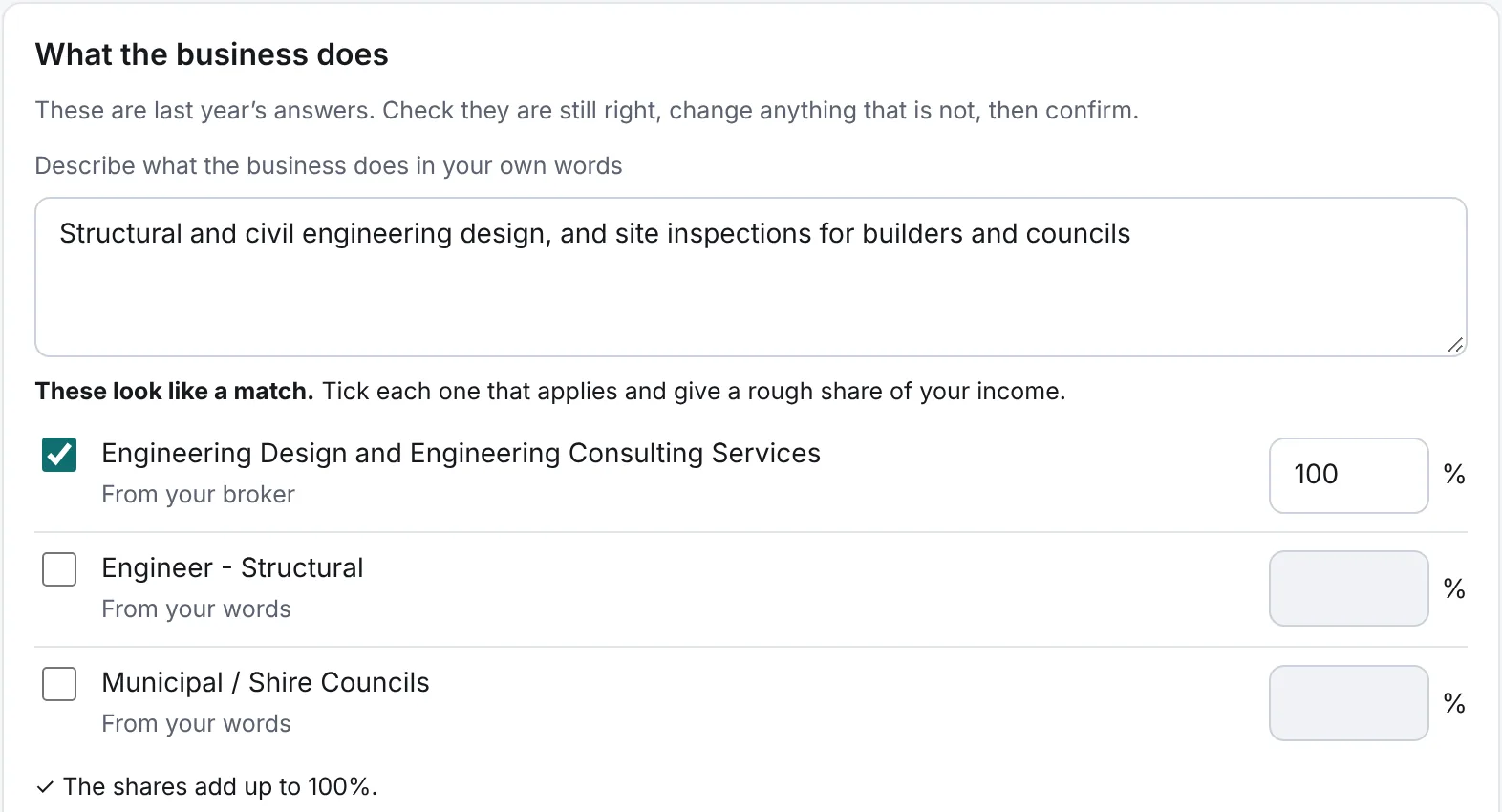
The client completes the fact-find on a form designed for a phone, in their own words. The industry list suggests the activities and covers that fit, the broker confirms them before anything goes to an insurer, and at renewal the client confirms last year’s answers instead of starting again.
Placement: one send to every market that fits
Placement is where most of the re-keying happens, and where most of the time goes. Here it is one sequence on one record.
Choose how to place it
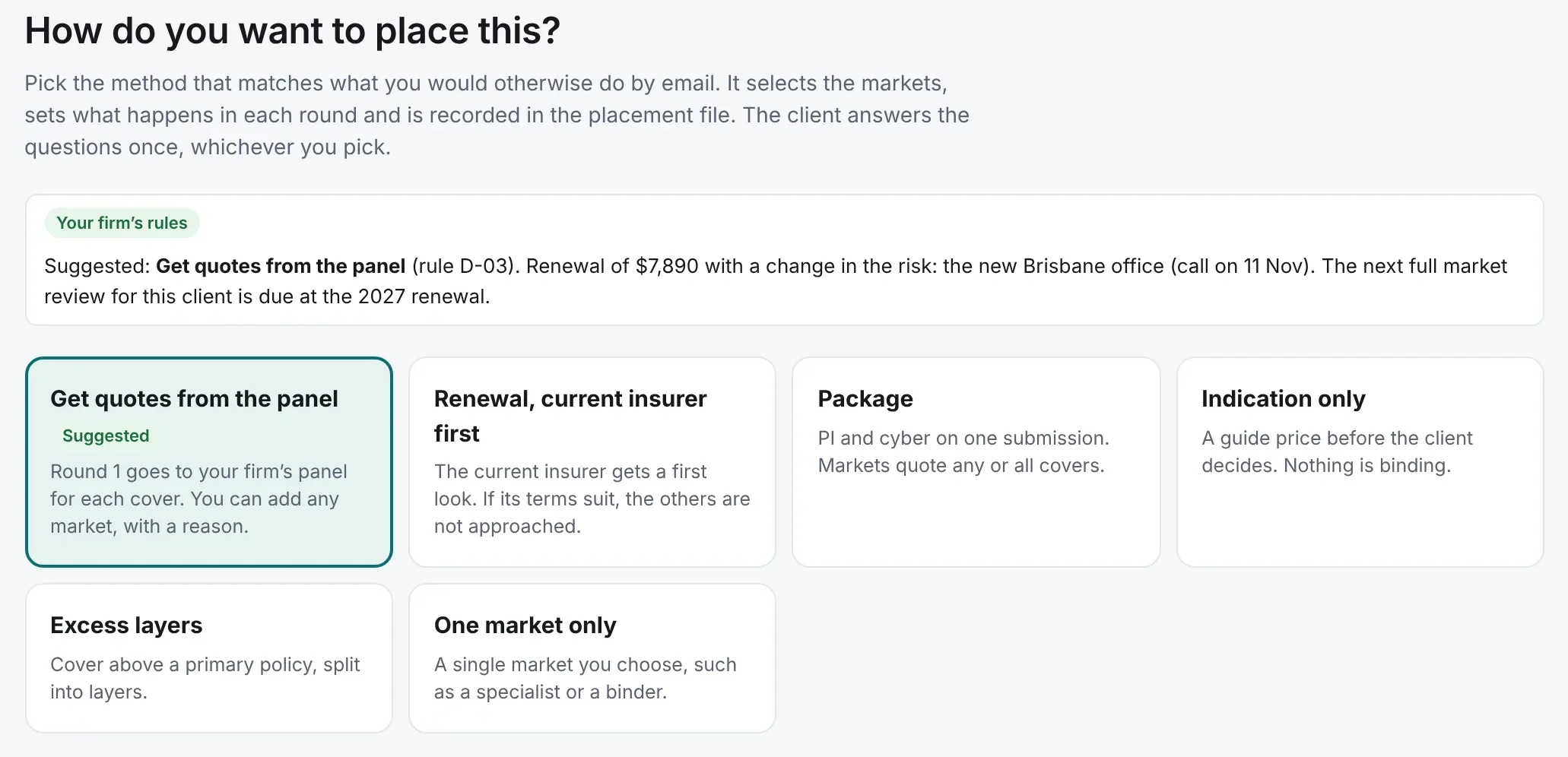
The broker picks a method: quotes from the firm’s panel, several covers on one form, the current insurer first at renewal, an indication only, excess layers, or one market only. The firm’s own rules suggest a method for each client, and the choice is recorded with the placement.
Choose the markets
The broker sees the markets whose appetite and limits fit the risk, in alphabetical order; Cuttleflow does not rank them. Panel markets are marked. Where a market needs more than the standard questions, its extra questions appear before anything is sent, with the market’s reason, so the client answers once. Underwriters the broker already uses who are not on the platform are invited as guests: each gets a link and quotes on the same template, without an account.
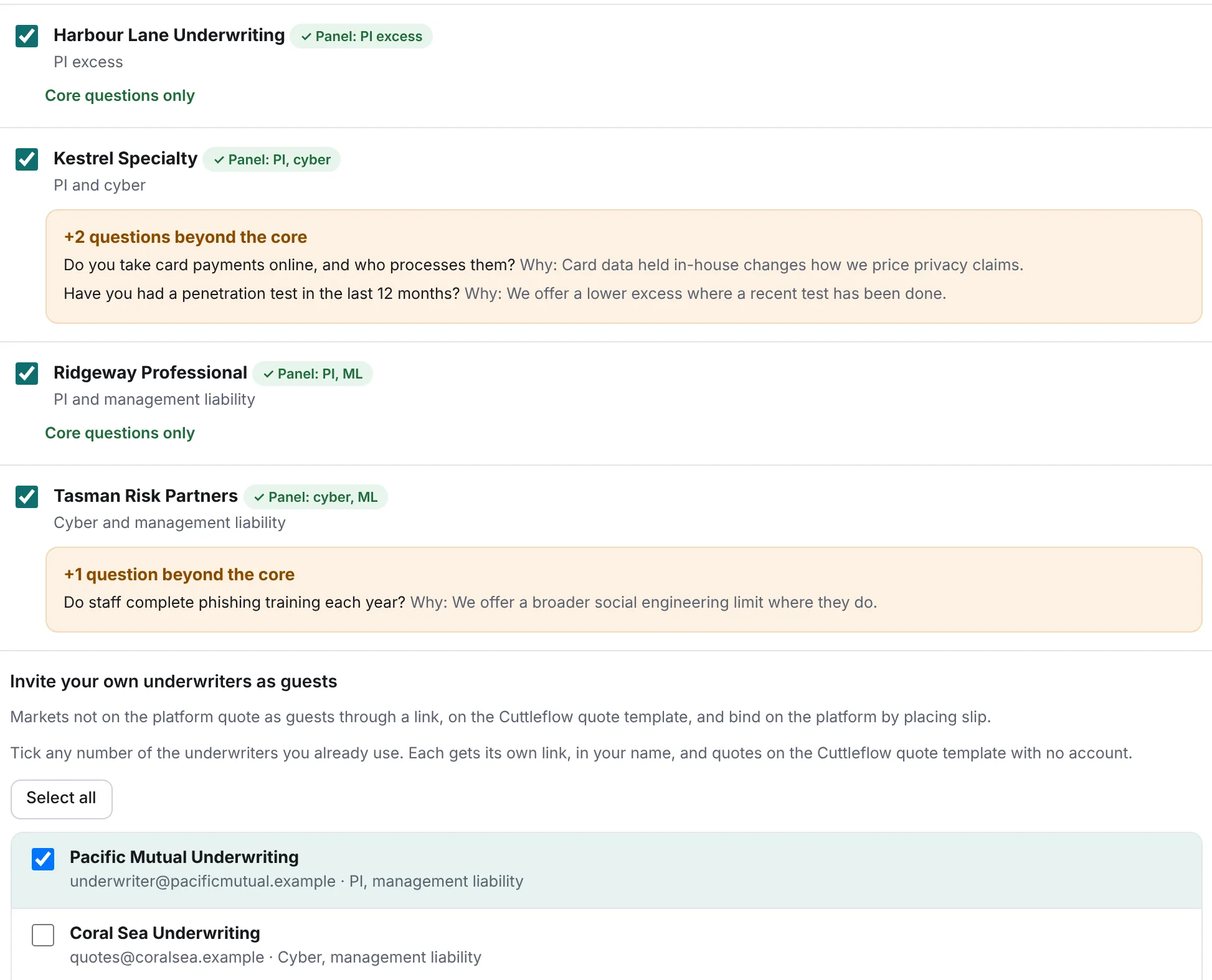
One send goes to every market chosen. Markets on the Cuttleflow Marketplace receive the same question set and the same wording, so their quotes compare like for like. The broker sees each market’s status as it changes: sent, opened, quoted, referred with a reason, or declined.
Compare and bind
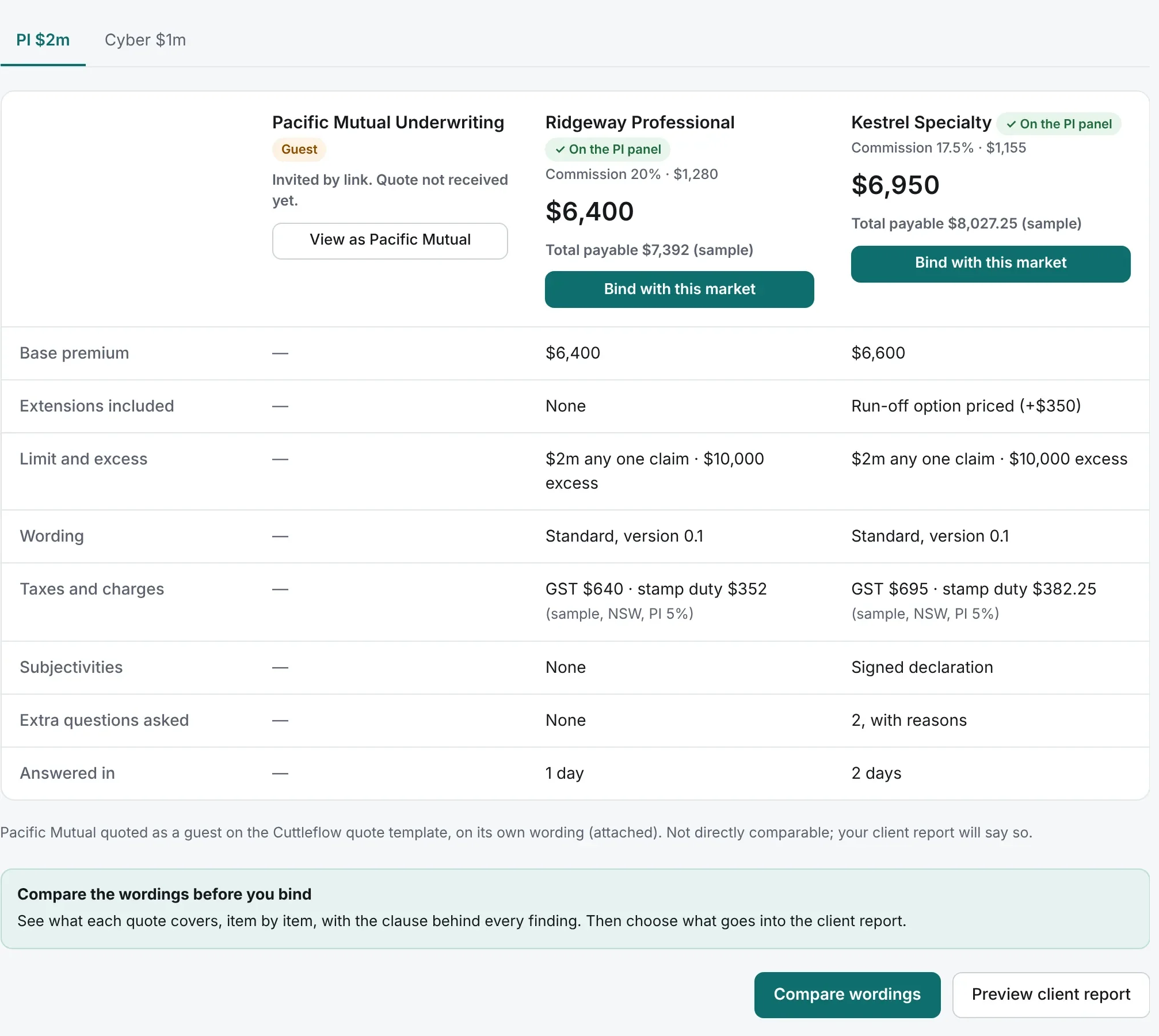
Quotes arrive in one table: premium, total payable, extensions, limit and excess, wording, taxes and charges, conditions and how long each market took. The commission on each quote sits beside its premium. A quote on a different wording, or with taxes not yet complete, is flagged before it can be bound. The broker binds online on the quote the client chose, and the bound policy goes to the broker’s own system for invoicing and the trust account.
The placement file is filled in as the broker works
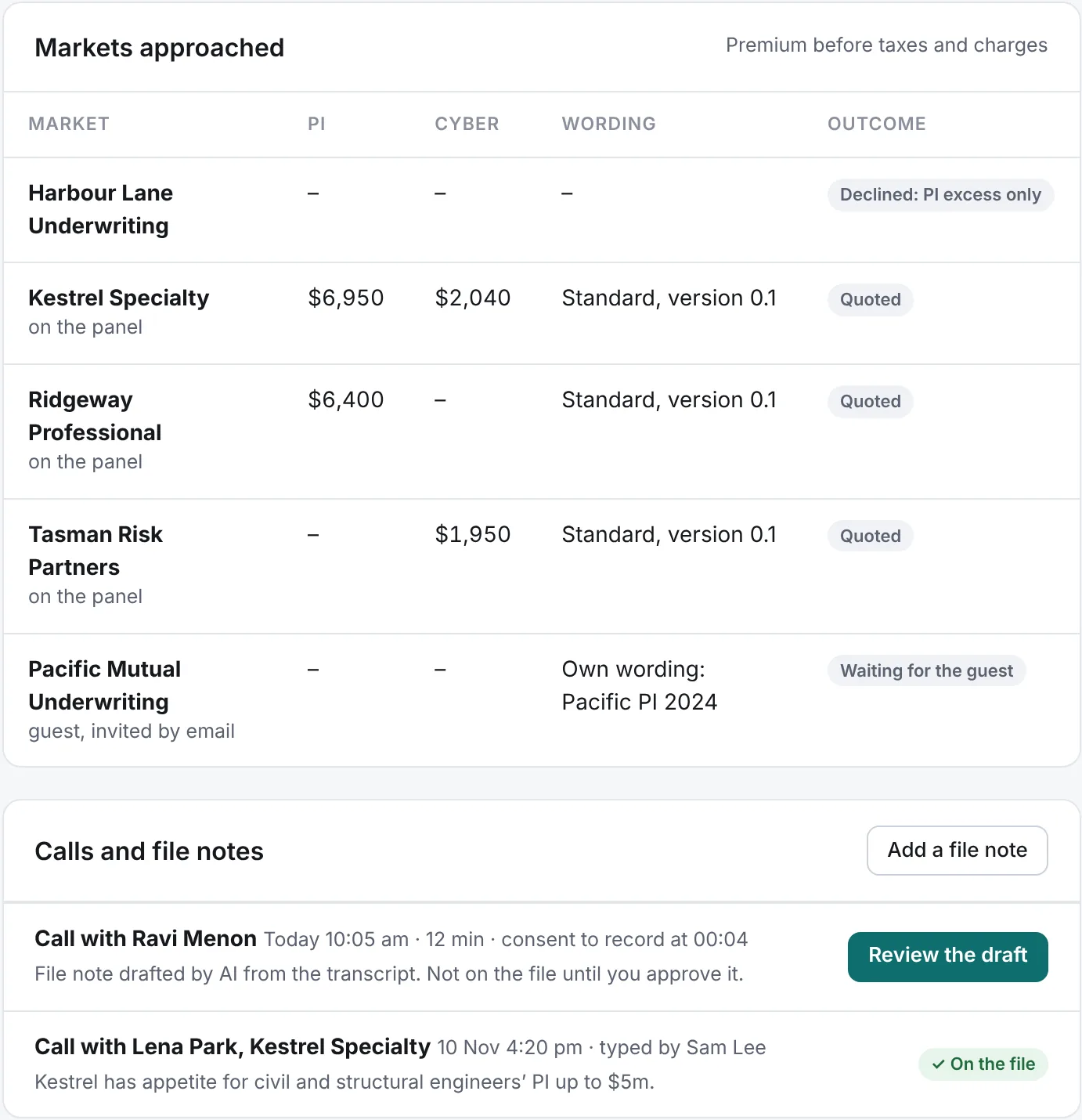
Every step writes to the placement file as it happens: the method and why, the markets approached and their answers, calls and file notes, and a dated history. A call recorded with the client’s consent becomes a draft file note for the broker to approve. The file is complete when the placement is.
The client report, assembled from the placement
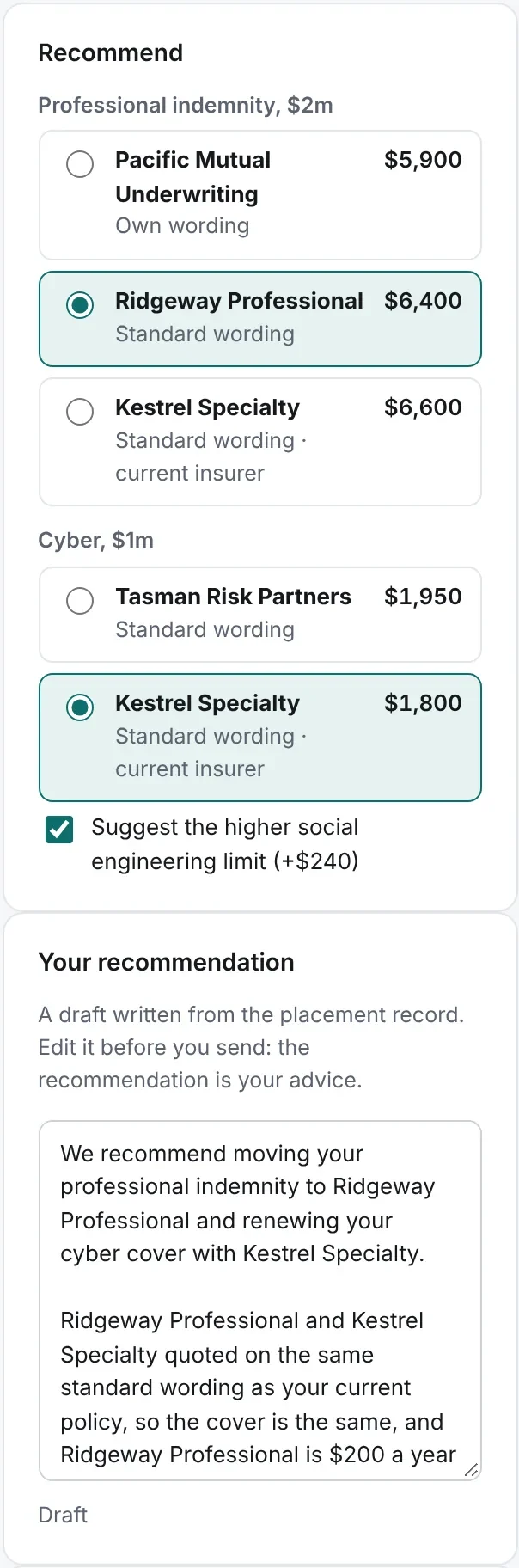
When the last quote is in, the client report is ready to review. It is built from the placement record and from benchmarks across renewals placed on the Marketplace. The broker picks what to recommend. Cuttleflow drafts the recommendation from the record, and the broker edits it, because the recommendation is the broker’s advice. The broker chooses the sections to include and sends the report in the firm’s name and colours.
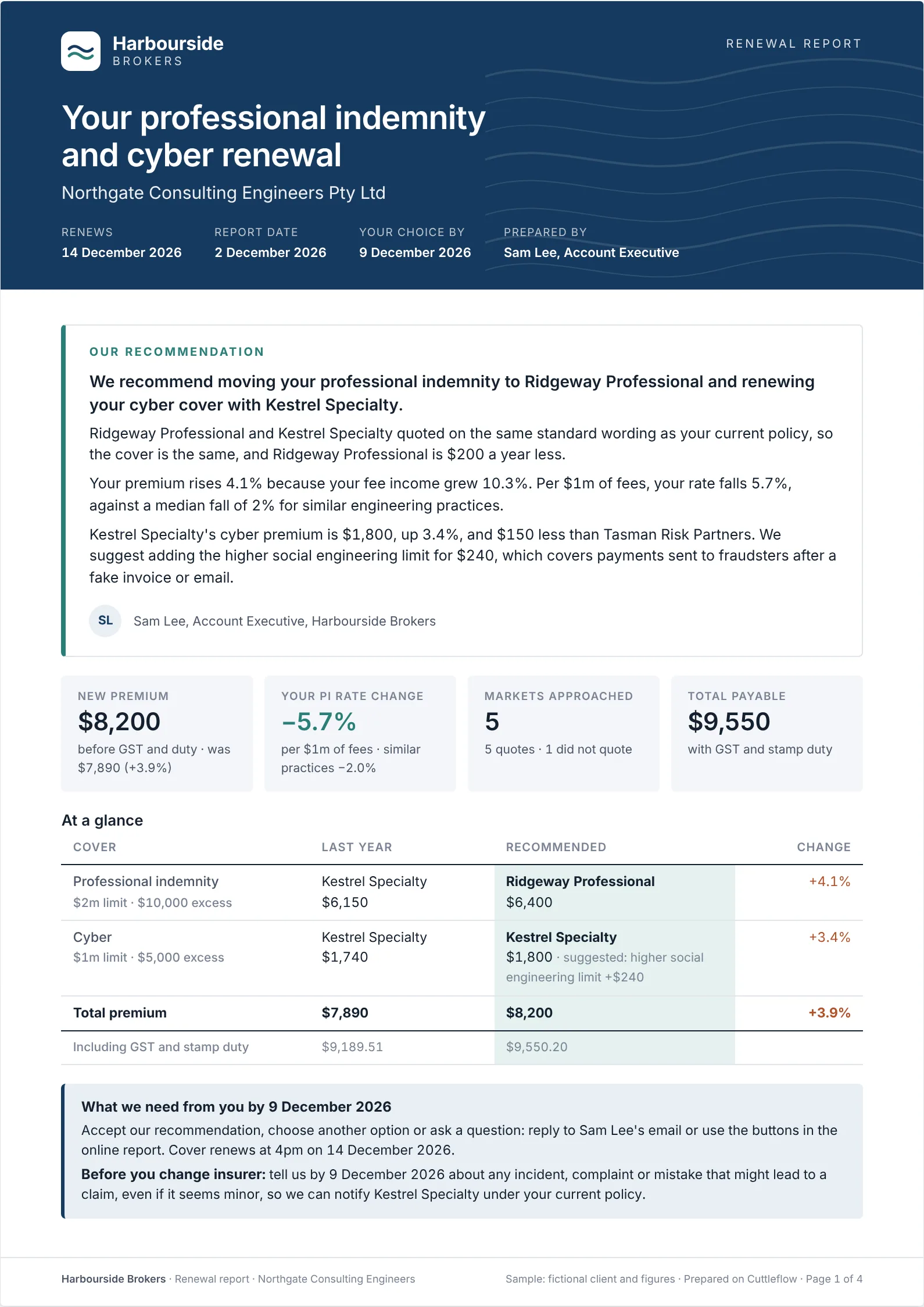
The report the client receives covers:
- Our recommendation on one page, with the new premium, the change in rate, how many markets were approached, the total payable, and what the client needs to do and by when.
- What each market offered, side by side, including the catch in the cheapest quote and the reasons for the recommendation.
- Your renewal so far: the dates from the client’s answers to the report.
- How the renewal compares with similar businesses: income, premium and rate against a group of similar renewals, shown only when the group is large enough that no client, broker or insurer can be identified.
- A cover the client does not hold, with an indicative price range. The report is also a cross-sell.
- Covers the client chose not to take, with the date and the reason.
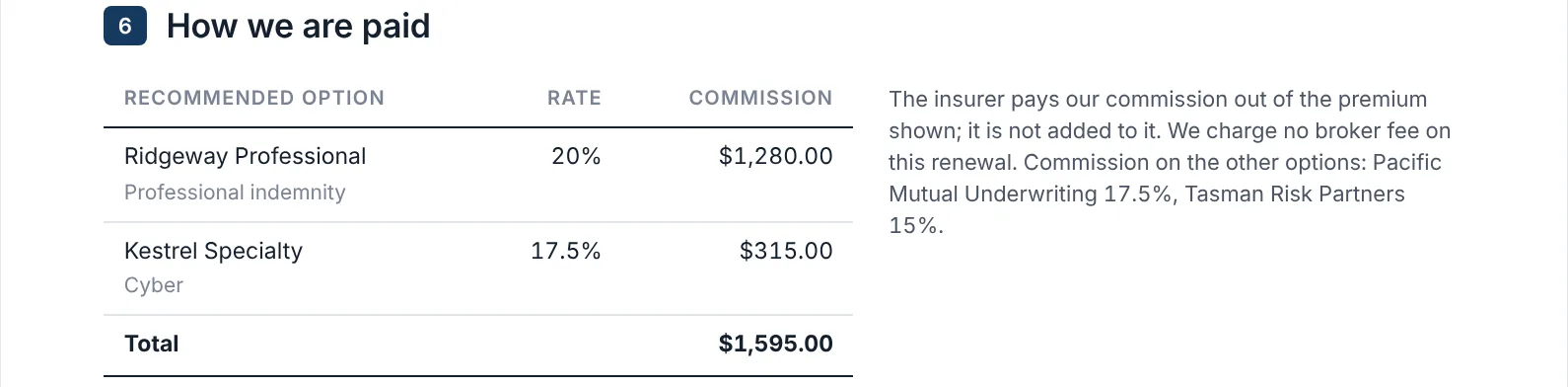
- How we are paid, in dollars, for each option.
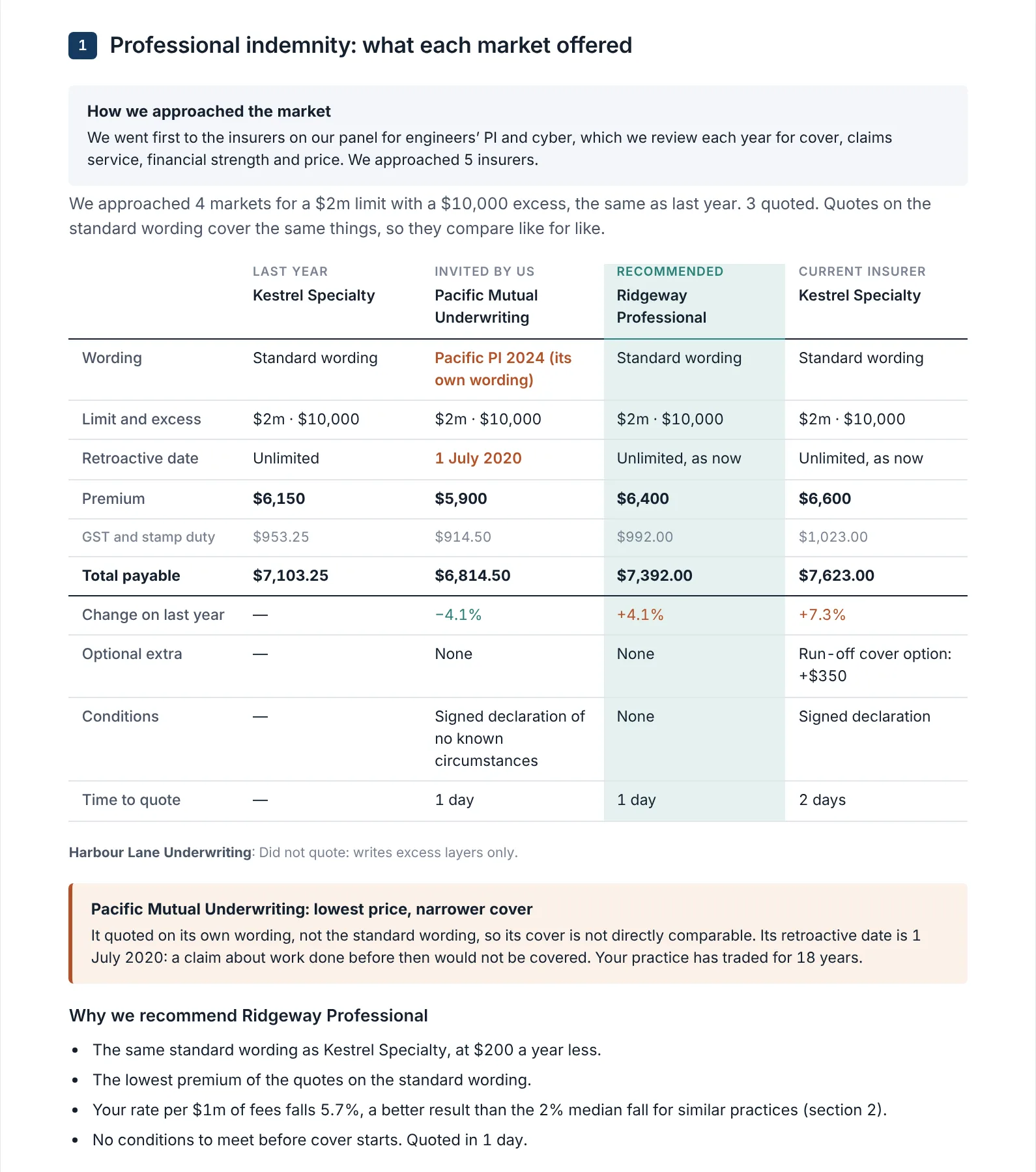
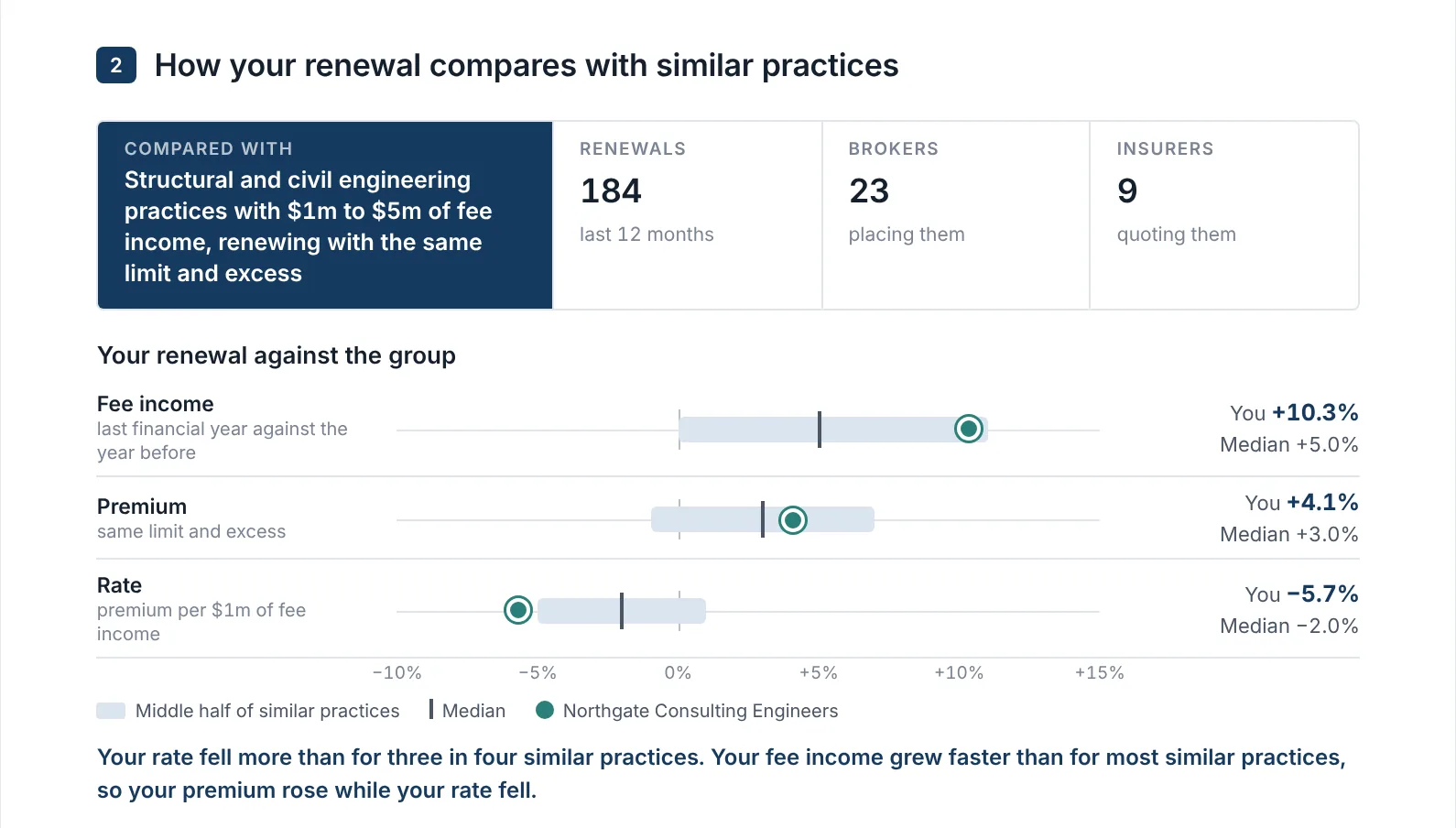
The client reads the report online and replies with one click: accept the recommendation, choose another option, or ask a question. The reply is recorded as the client’s instruction, and the broker binds.
The new Insurance Brokers Code of Practice applies from 1 January 2027. Clients will be able to ask what their broker is paid and get the answer in dollars, the notice before a renewal doubles from 14 to 28 days, and a new section covers how client records are kept (Insurance Business, 2026). A broker working from this record already has the commission in dollars on every option, the renewal date on every policy, and the client’s file in one place.
Next year’s renewal starts from the same record. The policy appears on the broker’s renewal list in time to give notice, the client confirms last year’s answers, the markets are approached again, and the new report shows the change on last year.
What a broking firm gets
- Leads that arrive ready to place, with the answers, the price the business saw and its consent.
- Less typing. The client’s answers go to every market once.
- Faster to market. One send, every market’s status in view, and guests included.
- Like-for-like comparison on the standard wording, with the differences flagged.
- A client report ready when the quotes are in, in the firm’s name, with a cross-sell built in.
- A complete file when the placement is done, and a renewal that starts from it.
The objections
- “We already have a broking system.” Cuttleflow works alongside it. Bound business goes across for invoicing and the trust account, and the broking system stays the ledger.
- “Our markets will not use another platform.” Underwriters who are not on Cuttleflow quote as guests from a link, on the same template, without an account.
- “Our report is our brand.” The report carries the firm’s name and colours, and the broker writes the recommendation.
Where Cuttleflow sits
The underwriter workspace, and the broker workspace for brokers an insurer appoints, are being tested ahead of a first client go-live. The placement screens, quote comparison, placement file, client report and schemes shown here are from a gated demonstration with fictional data. Price My Risk and leads from the public marketplace are in development. The Cuttleflow Marketplace is not yet open for live business, and each class opens only when its conditions, including licensing advice, are met.
Sources
- Brokers battling high admin, compliance burden: survey, insuranceNEWS.com.au, 21 March 2024, reporting JAVLN’s Brokering Change survey of 500 brokers
- Re-keying and workflow friction are costing carriers placement, Ivans survey finds, Risk & Insurance, 28 August 2026, reporting the Ivans 2026 Agency-Carrier Connection Report
- New broker code launches with stronger disclosure and transparency obligations, Insurance Business, 19 October 2026
- Insurance Brokers Code of Practice, NIBA
This piece describes a workflow and a software model in general terms. It is general information, not legal advice. Screens shown are from a demonstration with fictional businesses, brokers, markets and figures. Cuttleflow Pty Limited trading as Cuttleflow Systems is a software provider. It does not hold an Australian financial services licence and does not issue, arrange or advise on insurance. Brokers and underwriters advise, quote and bind under their own licences.
Cuttleflow Systems · Perspective 30 · 33°53′S · 151°16′E · Sydney