Demo · not open for live business
The Cuttleflow Marketplace is being built with the brokers and markets who will use it. It is not open for live business, and nothing on these pages or in the demo is a quote, an offer or cover. Cuttleflow Pty Limited does not hold an AFSL and does not issue, arrange or advise on insurance products. Each class opens only when its opening conditions are met, including licensing advice.
For insurers, agencies and coverholders
Deal flow, structured and curated.
Submissions that are complete, on one standard, and already checked against your own underwriting rules. Quote on the standard wording, price wherever you price today, and help shape the standard before the class opens.
Cuttleflow Go
Start with Cuttleflow Go.
Markets will join the Marketplace through Cuttleflow Go: a product on the standard wording with your own rates and rules, useful on its own from day one. Go is in development. About Cuttleflow Go →
How your appetite is read
Your rules decide what you see.
Your appetite is your classes, your maximum limits and your underwriting rules. Before a submission is offered to you, the platform runs your rules against the client’s answers. If a rule would decline it, you are not offered it. For example, a rule declining any geotechnical engineering means engineering firms that do geotechnical work are not sent to you. If a rule would refer it, you see it marked for referral with the authority level required.
We encourage markets to state appetite as underwriting rules as well as limits. The more precise your rules, the fewer submissions you see that you would decline.
The rules engine
- Rules are built on the standard’s data fields. Conditions are true-or-false tests and can be chained.
- Each rule gives one of three results: accept, refer with the authority level required, or decline. Every rule is evaluated; any decline declines, otherwise any refer refers.
- Your rules are private to you and can be tested on sample risks in the demo.
- Authority is enforced by the platform.
Pricing
Price where you price today.
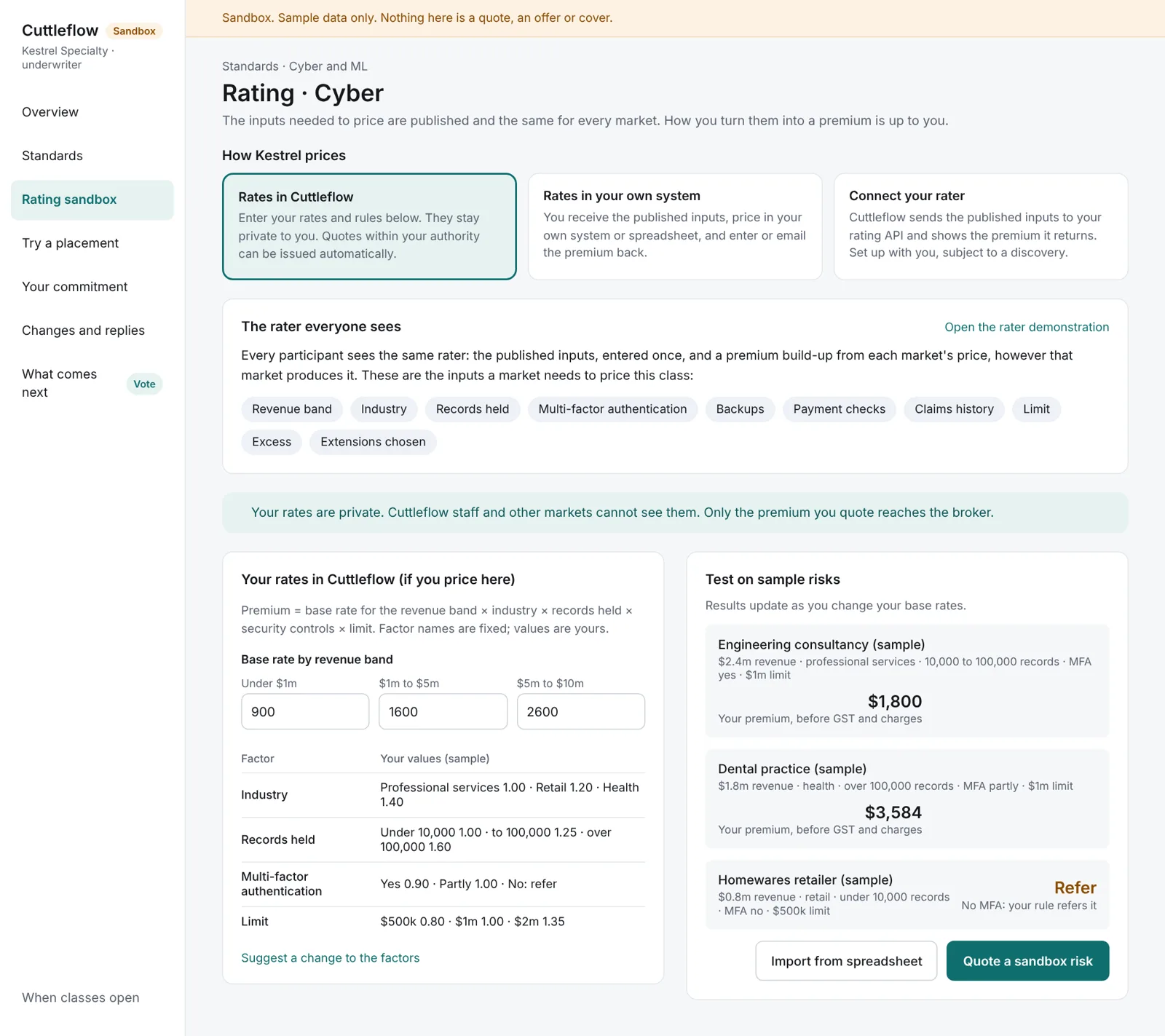
Your rates can sit inside Cuttleflow, stay in your own system with the premium entered on the platform, or arrive through an API. Every market sees the same published rating inputs, so you know exactly what information you are pricing.
You can add a few questions of your own at the edge of the standard. Each one carries a reason that the broker and the client can see, and the client answers it only when the broker chooses you.
Indicative prices · in the demo
Publish indicative rates. Bind online within your own authority.
If you opt in, brokers on Cuttleflow can offer an indicative price from your rates on their own channels: links in their emails and newsletters, the proposal forms they send, their websites, partners’ systems through the API, and AI assistants. The client then answers the remaining questions and gets a firm quote from you.
- Your own rating. The indication uses the same rater and rate version as your firm quote. Your referral rules run before any firm quote.
- Your rates stay protected. Prices are worked out on Cuttleflow’s servers and shown only as rounded figures. Calls are rate-limited, and repeated changes to one answer pause the price.
- Named at the firm quote. Before then, the client sees a range, shown only when two or more insurers price the risk, or a price “from a participating insurer”.
- Online bind only if you allow it. You make the firm offer under your own binder or binding authority, and the broker arranges the client’s acceptance. Online bind is switched on for you only after you confirm in writing that your authority allows it, and only within the limits you set. For a Lloyd’s coverholder, this is agreed through its managing agent.
Prices go live class by class, as insurers opt in.
Members and guests
Two ways to quote.
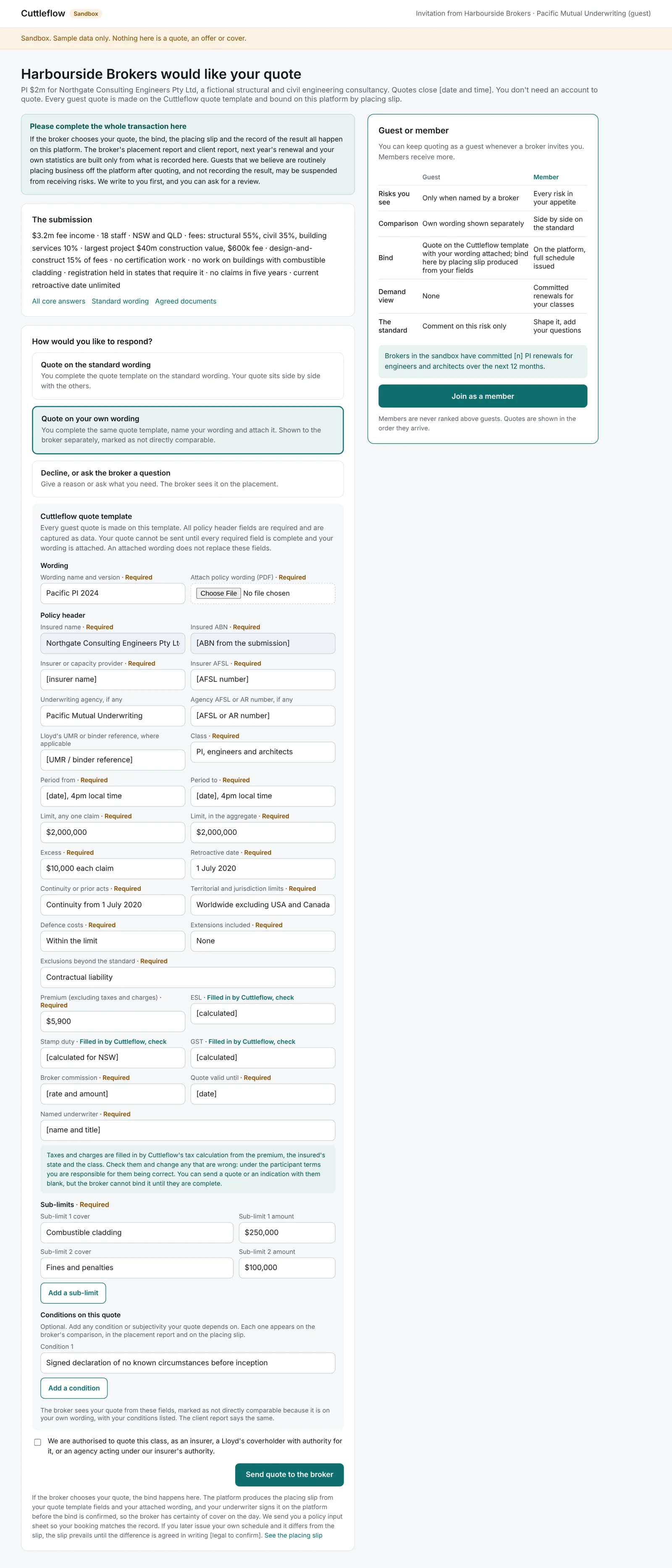
| Guest | Member | |
|---|---|---|
| Risks you see | Only when a broker names you | Every risk your rules accept, unless a broker’s filter excludes you for that placement |
| How you quote | On the Cuttleflow quote template, with every policy header field completed; on the standard or your own attached wording, with any conditions | On the standard wording |
| Comparison | Shown separately if on your own wording, marked as not directly comparable | Side by side on the standard |
| Bind | On the platform, by placing slip produced from your template fields | On the platform, full schedule issued |
| The standard | Comment on the risk you quoted | Shape it, add your questions |
Members are never ranked above guests. Quotes are shown to the broker in the order they arrive. The reasons to join are the full flow of risks your rules accept, comparable quotes that brokers can place quickly, and a say in how the standard develops.
Documents and booking
Agreed documents, and a sheet to book from.
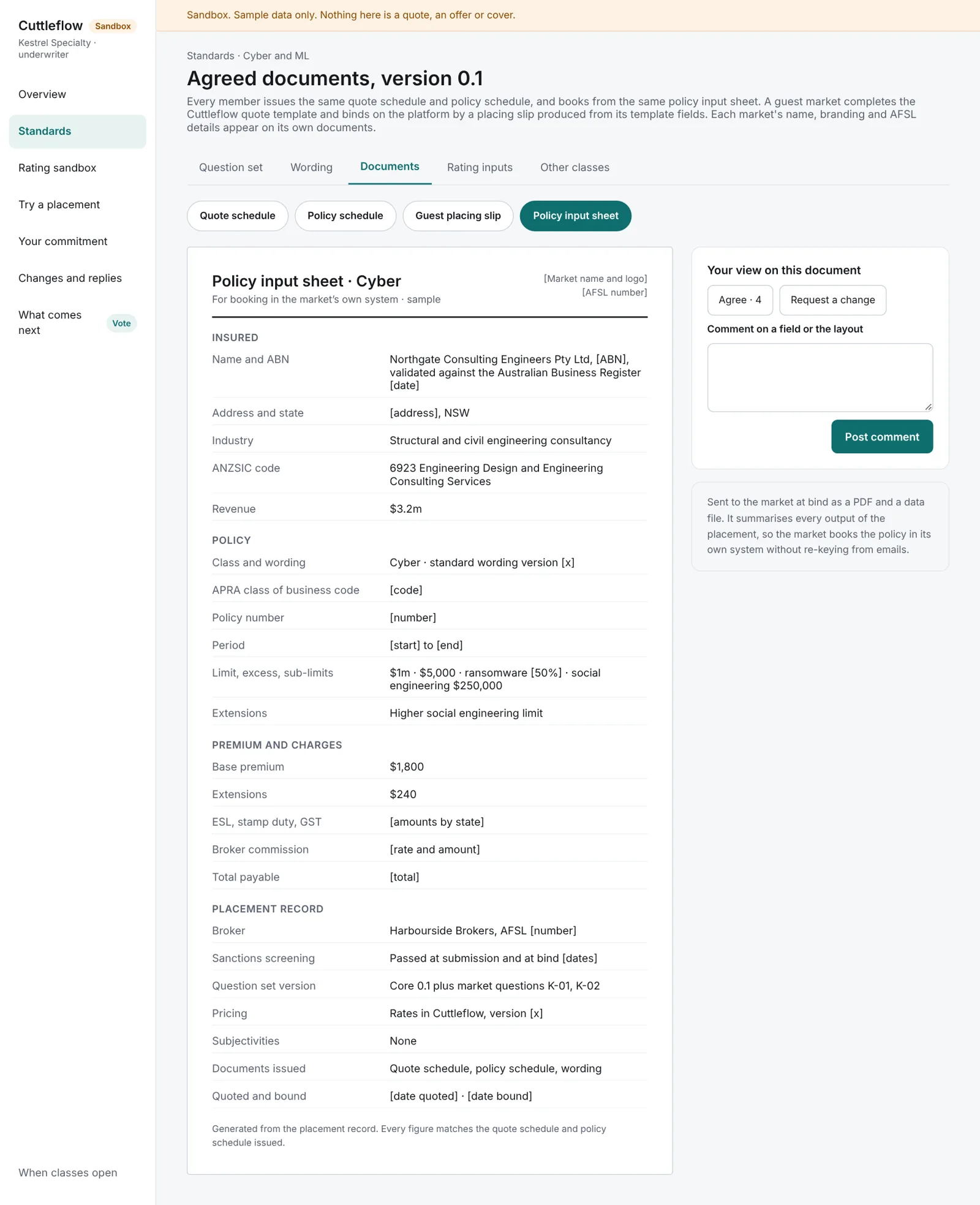
Each standard includes an agreed quote schedule, policy schedule and policy input sheet. The input sheet summarises every output of the placement: the insured with ABN and ANZSIC industry code, the class with its APRA class of business code, cover, limits, excesses, premium build-up, taxes and charges, commission, dates, extensions, subjectivities, documents issued, and the question set and rating versions used. You book the policy in your own system from one consistent record.
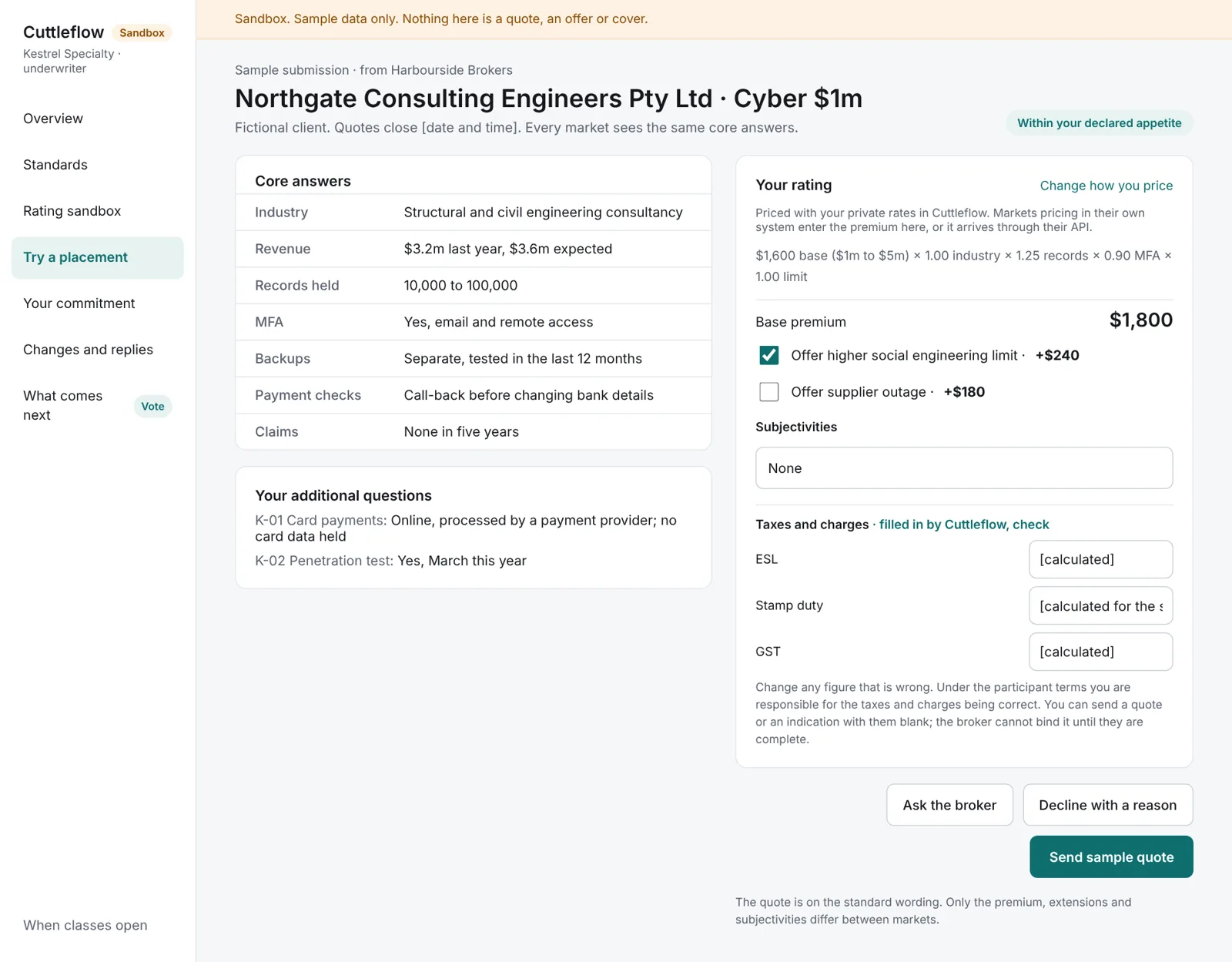
Taxes and charges. When you quote, the platform fills in ESL, stamp duty and GST from the premium, the insured’s state and the class, using a fixed calculation. You check the figures and can change them. Under the participant terms you remain responsible for them being correct. You can issue a quote or indication without them, but it cannot be bound until they are complete.
Next: the production-ready sandbox
After the demo, invited markets will use a production-ready sandbox to:
- Review the standard question set and wording for your classes, and send Cuttleflow your comments on each question and clause.
- Build your appetite as underwriting rules and limits, and test it on sample risks.
- Choose your pricing route and quote sample submissions.
- Give a non-binding intention to quote on version 1.0, with your appetite and response time.
Taking part in the demo or the production-ready sandbox does not commit you to quote. The platform is free during the Beta testing period, with charges to follow. Charges will be published before any class opens for live business.