cuttleflow
Systems
The launch · Sydney · 10 September 2026Fourteen slides · about nine minutes

The launch deck.

Fourteen slides, and what was said over them. Cuttleflow Systems launched at lunchtime on 10 September 2026, 29 floors above Martin Place, hosted by Sparke Helmore Lawyers. This is the argument Max Broodryk made in the room — the slides as shown, the notes as spoken, and every source linked.

Max Broodryk · FounderLevel 29, 25 Martin Place, SydneyAll events
← → move between slides · T shows the slide rail Open in its own tab ↗
In short

Underwriting agencies write about a fifth of Australian general insurance and are the part of the market that is growing. What has held them back is not appetite but plumbing: the policy system, accounts, bordereaux, compliance, IT and document production that must exist before the first policy earns — historically a year and $300,000 to $1 million. Cuttleflow Systems is one system, on one record, from the broker’s email to the renewal, with a product defined as configuration rather than code. AI reads; humans and deterministic rules decide. The system moves four numbers — cost to start, cost to run, cost to connect and revenue per person.

Title slide on a dark ground: the Cuttleflow bearing mark, the wordmark cuttleflow SYSTEMS, the line ‘Systems for underwriters, built by underwriters’ and ‘One system, from the broker’s email to the policy’. Max Broodryk, founder. Sydney, 10 September 2026.

Slide 1 of 14 · Title

Systems for underwriters, built by underwriters.

Open in the deck ↗

Good afternoon. I am Max Broodryk. I have spent four years getting a Lloyd's operation up and running in this market, and before that I set up an insurance branch in the Philippines from scratch. I have run claims, underwriting and finance. When you have done every job in an agency yourself, you stop seeing insurance as a strategy problem and start seeing much of it as an operational problem.

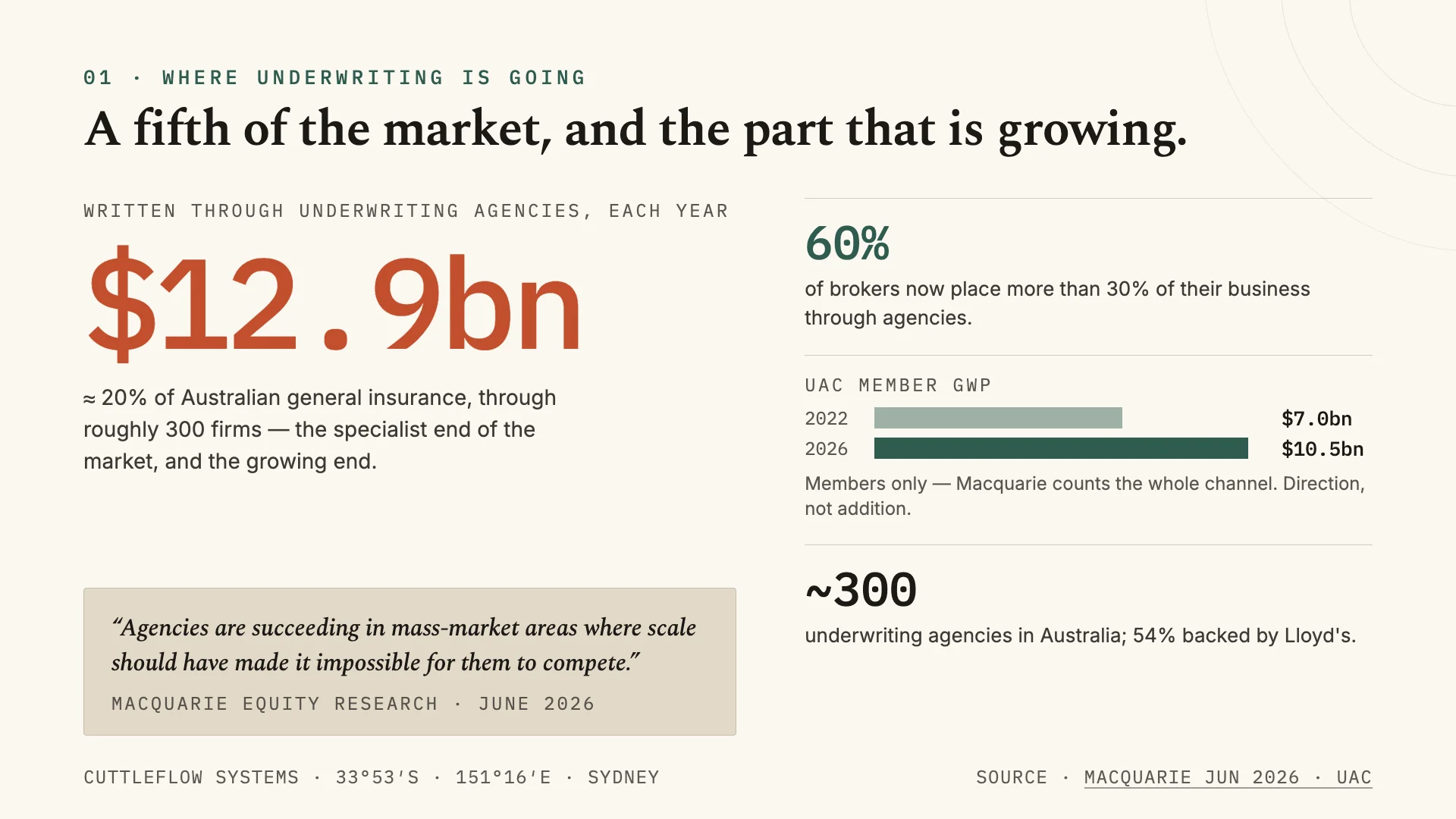
Slide: $12.9bn written through underwriting agencies each year, about 20% of Australian general insurance through roughly 300 firms. 60% of brokers place more than 30% of their business through agencies. UAC member GWP grew from $7.0bn in 2022 to $10.5bn in 2026. Around 300 agencies, 54% backed by Lloyd’s. Quote from Macquarie Equity Research, June 2026: agencies are succeeding in mass-market areas where scale should have made it impossible for them to compete.

Slide 2 of 14 · Step 01 · Market

A fifth of the market, and the part that is growing.

Open in the deck ↗

Some context first. Agencies now write about a fifth of Australian general insurance — on Macquarie's estimate, $12.9 billion a year through roughly 300 firms, more than half of them backed by Lloyd's. UAC members alone have grown from $7 billion in 2022 to more than $10.5 billion today. Those are two different populations — members versus the whole channel. Sixty per cent of brokers now place more than 30 per cent of their business through agencies. Brokers: this is already where your specialist capacity lives. Capacity providers: this is already where a large part of your book is written. Investors: this is the part of the market that is growing. And Macquarie — a bank that covers the listed insurers — says agencies are succeeding where scale should have made it impossible. Agencies broke the rule that scale wins.

Sources · Macquarie Equity Research, Jun 2026 · UAC · Basis set out in Perspective 13 — The market that wants founders

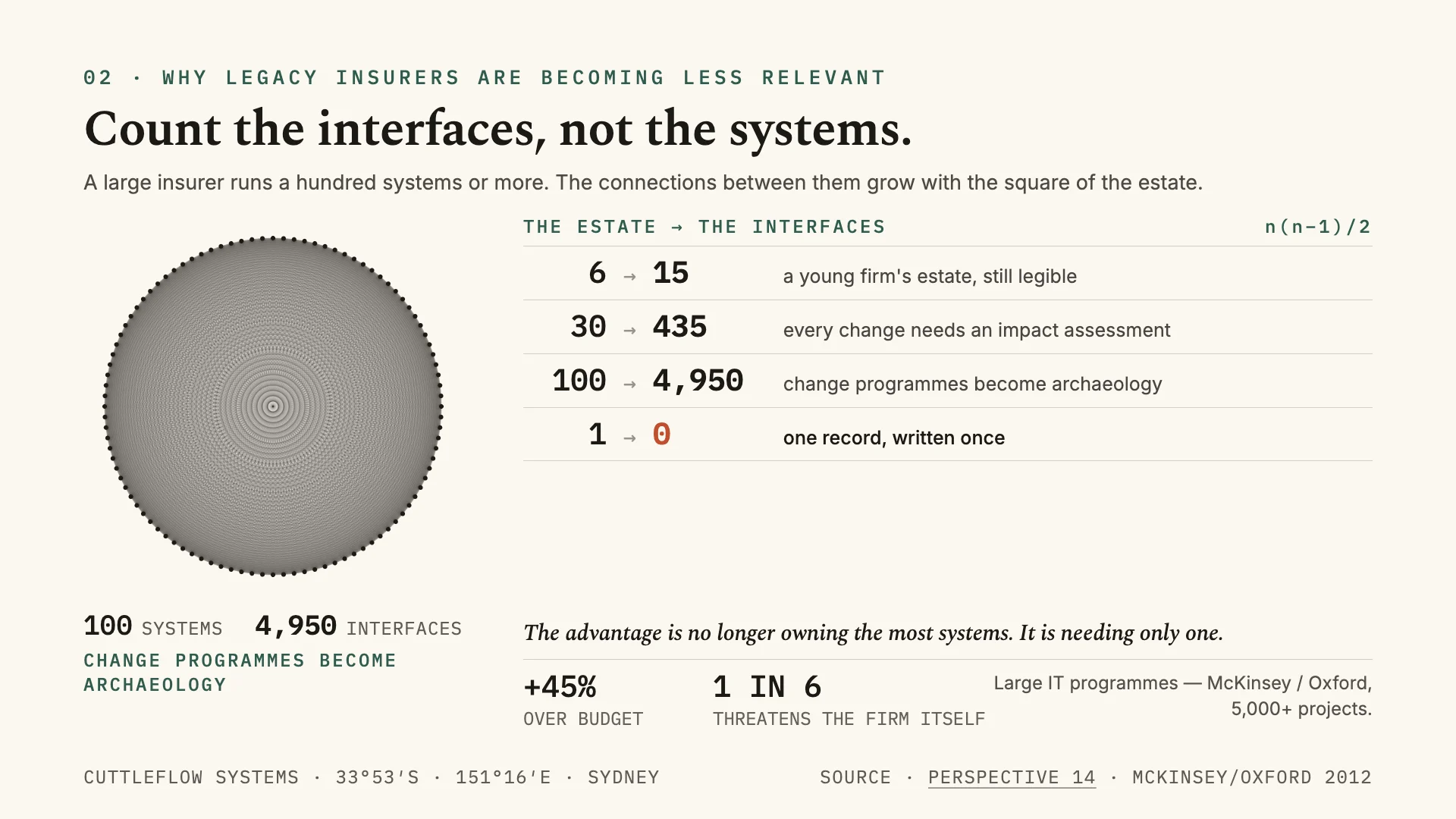
Slide: a ring of 100 systems joined by every pairwise interface, beside a table — 6 systems need 15 interfaces, 30 need 435, 100 need 4,950, and one record needs none. Large IT programmes run 45% over budget on average and one in six threatens the firm itself (McKinsey/Oxford, 5,000+ projects). The advantage is no longer owning the most systems; it is needing only one.

Slide 3 of 14 · Step 02 · Arithmetic of legacy

Count the interfaces, not the systems.

Open in the deck ↗

Why can't the incumbents simply catch up? Arithmetic. A large insurer runs a hundred systems or more — policy administration by era, claims by acquisition, finance by geography. Connections between systems grow with the square: six systems need fifteen interfaces, thirty need 435, a hundred need 4,950. Every interface is a place where two copies of the same fact can disagree, and reconciliation is the tax on those disagreements. Replacing the estate has been tried for twenty years. McKinsey and Oxford studied more than 5,000 large IT programmes: 45 per cent over budget on average, and one in six goes so badly it threatens the firm — while the old systems keep running, so the firm pays for both. The advantage is no longer owning the most systems. It is needing only one.

Sources · Perspective 14 — The arithmetic of legacy · McKinsey/Oxford 2012 (cited within it)

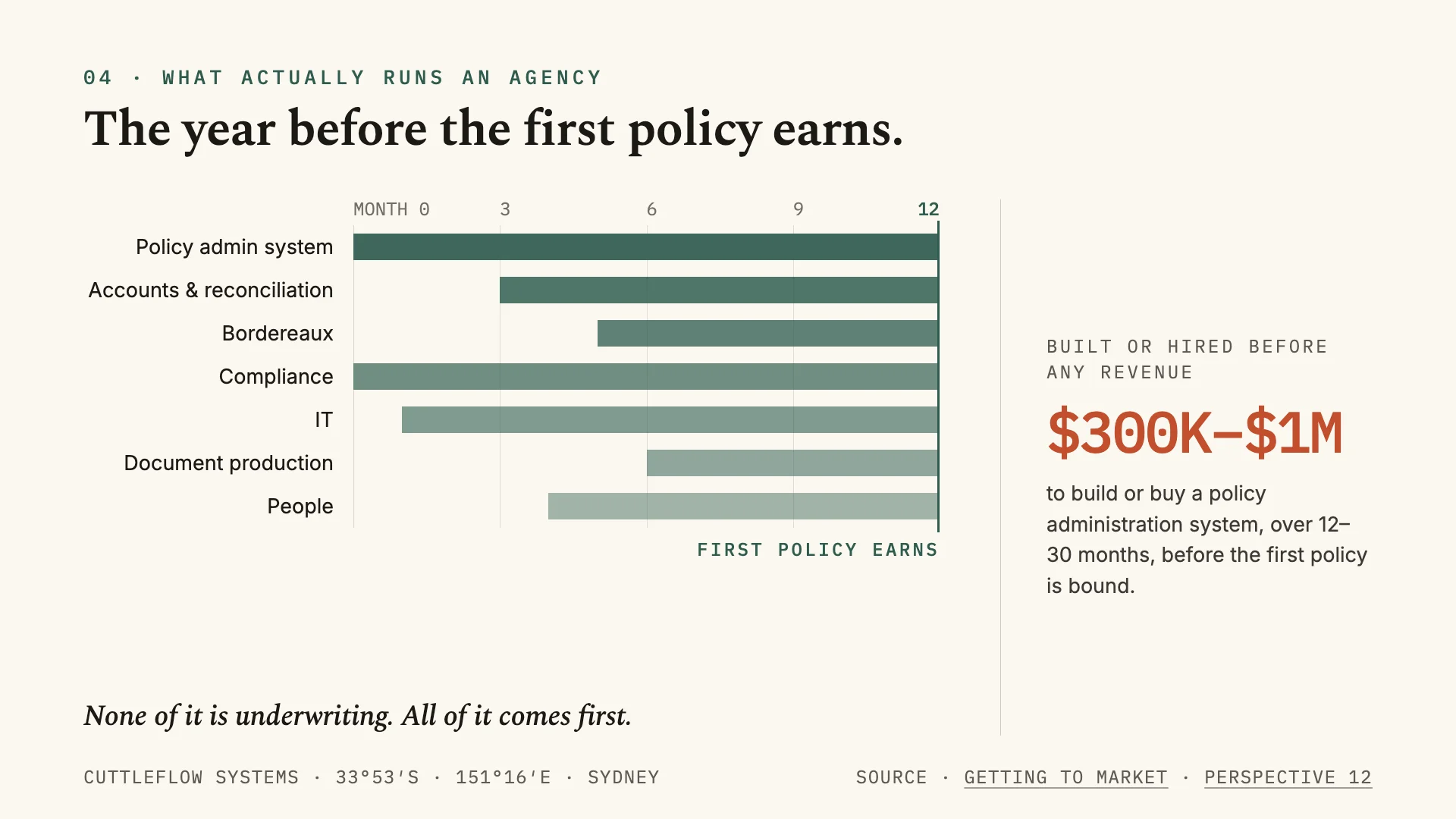
Slide: a twelve-month timeline of what a new agency must build before its first policy earns — policy admin system, accounts and reconciliation, bordereaux, compliance, IT, document production and people — with the note that a policy administration system costs $300K–$1M over 12–30 months. None of it is underwriting; all of it comes first.

Slide 5 of 14 · Step 04 · The year of plumbing

The year before the first policy earns.

Open in the deck ↗

People think an agency runs on appetite. It runs on plumbing. Before the first policy earns a dollar, a new agency has to build or buy a policy administration system — twelve to thirty months, $300,000 to a million dollars — then accounts, bordereaux, compliance, IT, document production, and the people to run all of it, hired before there is any revenue to pay them.

Sources · Getting to market · Perspective 12 — The pen is portable

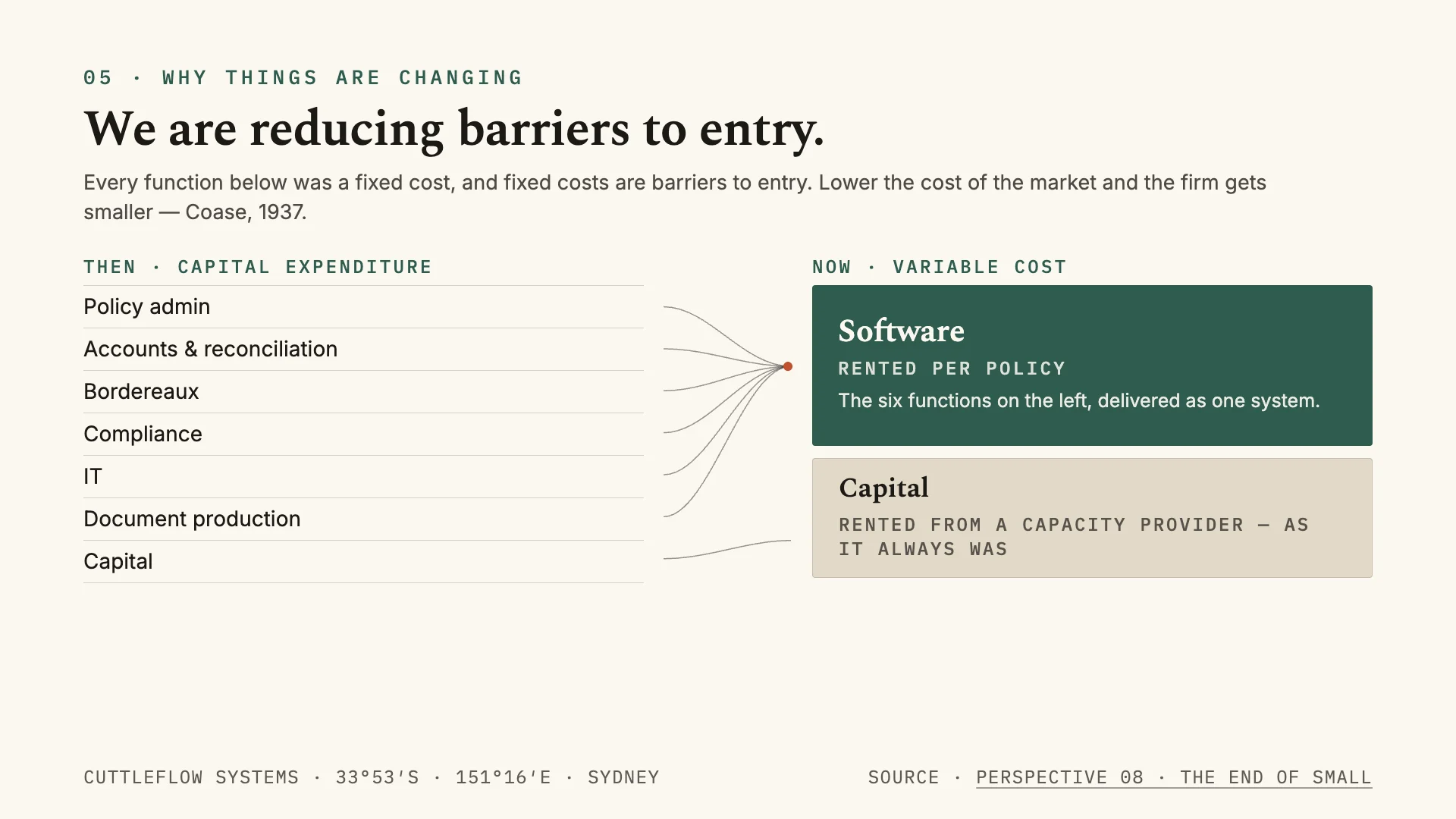
Slide: seven functions that were fixed costs — policy admin, accounts and reconciliation, bordereaux, compliance, IT, document production and capital — flow into two boxes: Software, rented per policy, and Capital, rented from a capacity provider as it always was.

Slide 6 of 14 · Step 05 · The barrier

We are reducing barriers to entry.

Open in the deck ↗

Why did it stay that way for so long? Because every one of those functions was a fixed cost, and fixed costs are barriers to entry. A firm had to be big enough to afford the back office before it could do any underwriting, so the underwriting lived inside big institutions — not because that was the best place for it, but because it was the only place that could afford it. That is changing. Six of the seven functions on the left have become software you can now rent by the policy. The seventh, capital, you were always going to rent from a capacity provider.

Sources · Perspective 08 — The end of small

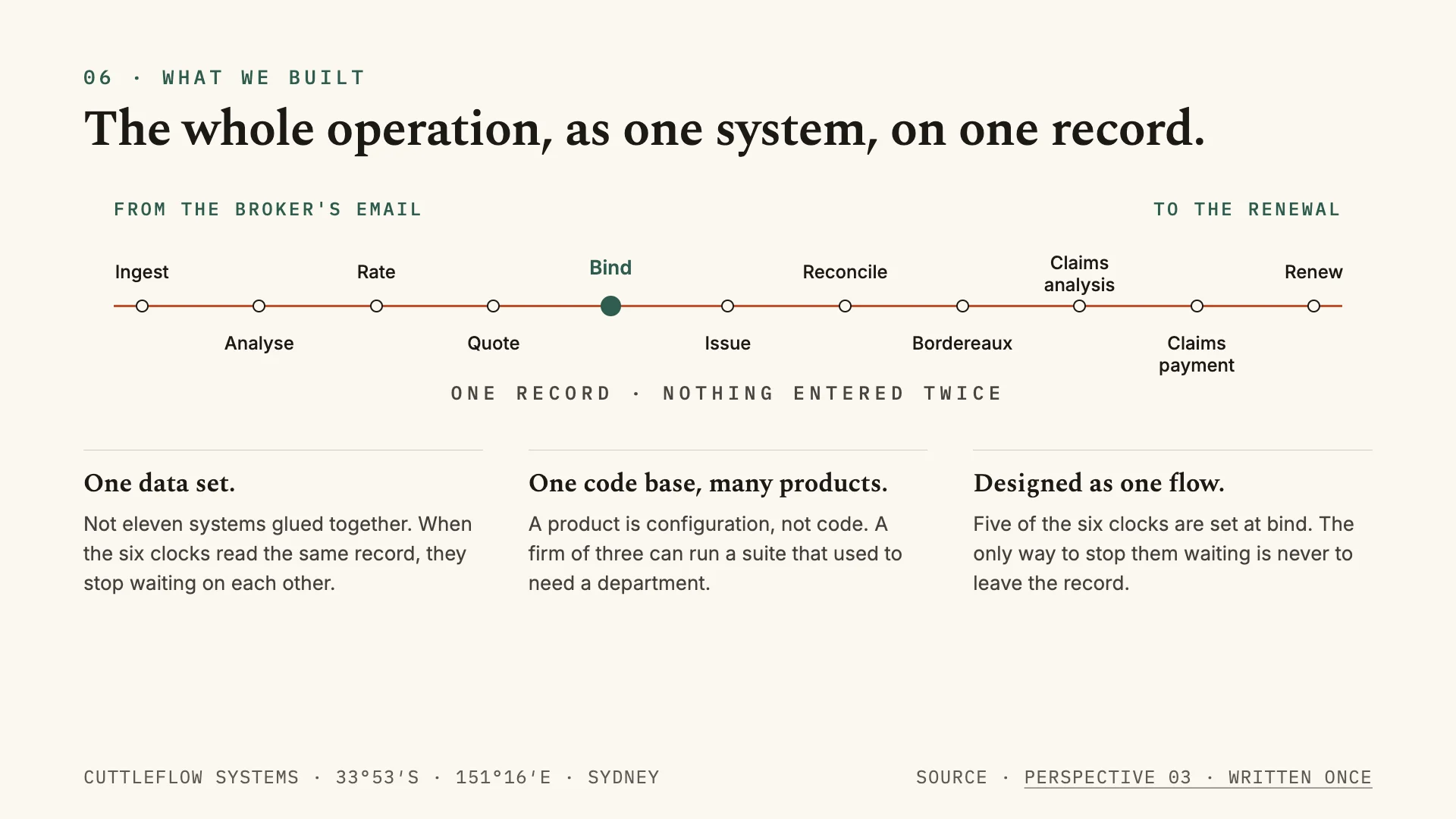
Slide: one line from the broker’s email to the renewal with eleven stations — ingest, analyse, rate, quote, bind, issue, reconcile, bordereaux, claims analysis, claims payment, renew — captioned ‘one record, nothing entered twice’, and three design decisions: one data set; one code base, many products; designed as one flow.

Slide 7 of 14 · Step 06 · One system

The whole operation, as one system, on one record.

Open in the deck ↗

So here is what we built: the whole operation as one system, on one record.

Ingest, analyse, rate, quote, bind, issue, reconcile, bordereaux, claims analysis, claims payment, renew — one flow from the broker's email to the renewal, with nothing entered twice.

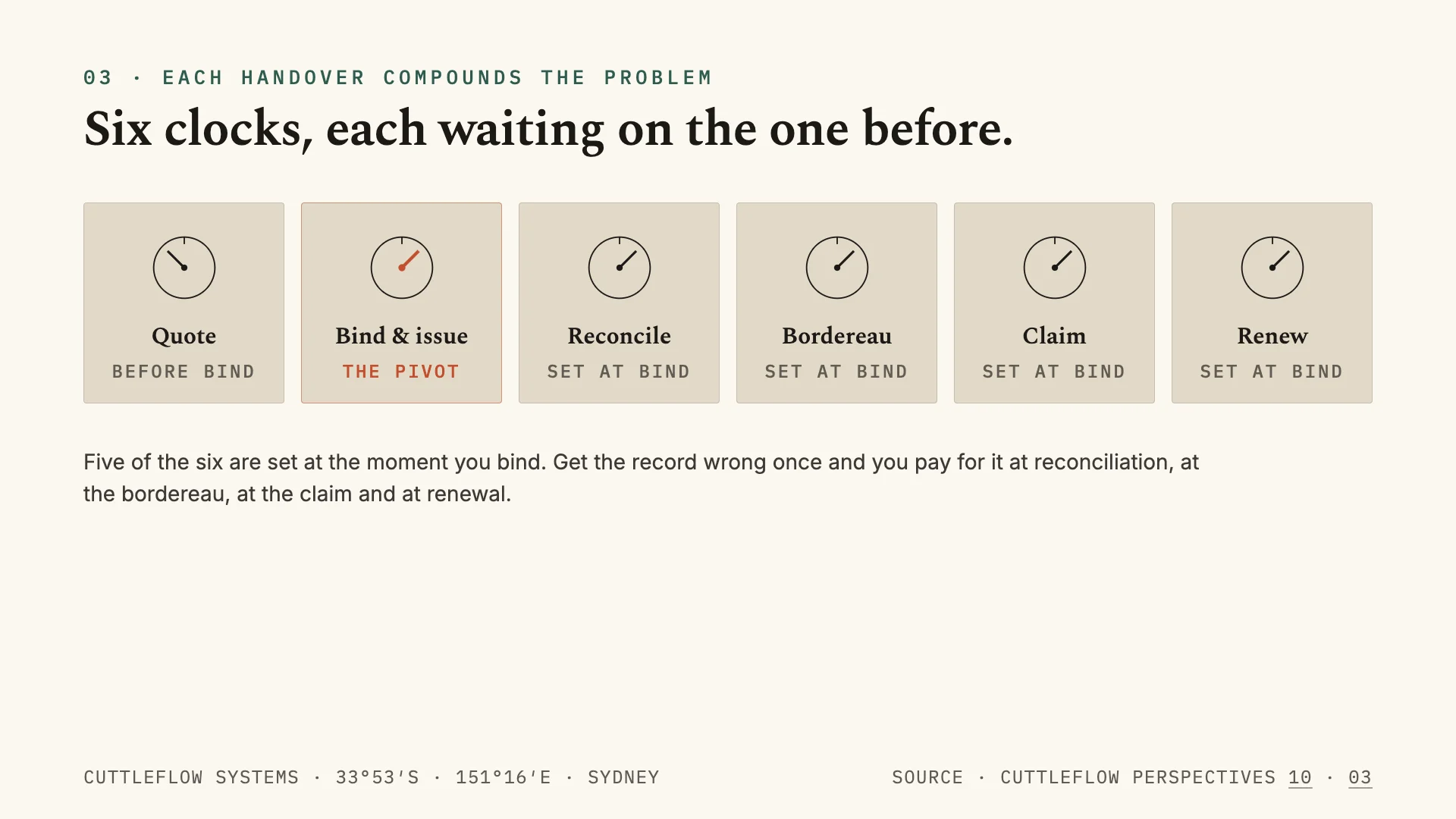
Three decisions sit under it. One data set, not eleven systems glued together, so the six clocks stop waiting on each other.

One code base, many products — a product is configuration, not code, so a firm of three can run a suite that used to need a department.

And the whole operation designed as one flow.

Sources · Perspective 03 — Written once · The platform

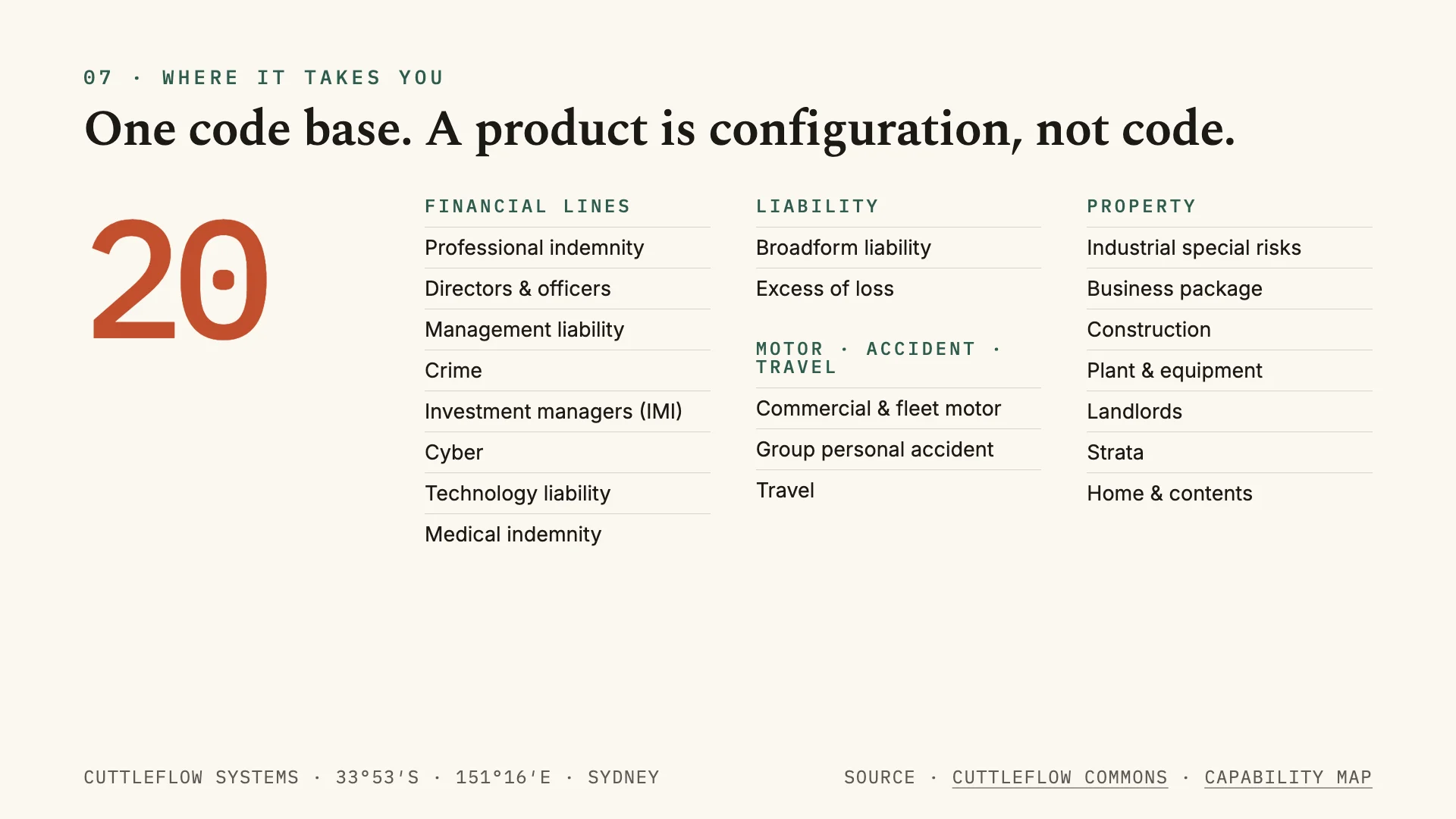
Slide: the number 20 beside the Meridian product classes — financial lines (professional indemnity, directors and officers, management liability, crime, investment managers, cyber, technology liability, medical indemnity), liability (broadform, excess of loss), motor, accident and travel (commercial and fleet motor, group personal accident, travel) and property (industrial special risks, business package, construction, plant and equipment, landlords, strata, home and contents).

Slide 8 of 14 · Step 07 · Twenty classes

One code base. A product is configuration, not code.

Open in the deck ↗

Because a product is configuration rather than code, one code base runs financial lines, liability, property, motor, accident and travel. The Meridian product set covers the twenty classes on this slide, with plain-English wordings published openly through Cuttleflow Commons — anyone can read them, use them and improve them. If you are a professional indemnity specialist today and want to add cyber next year, that is a configuration decision, not a build.

Sources · Cuttleflow Commons · Platform capability map

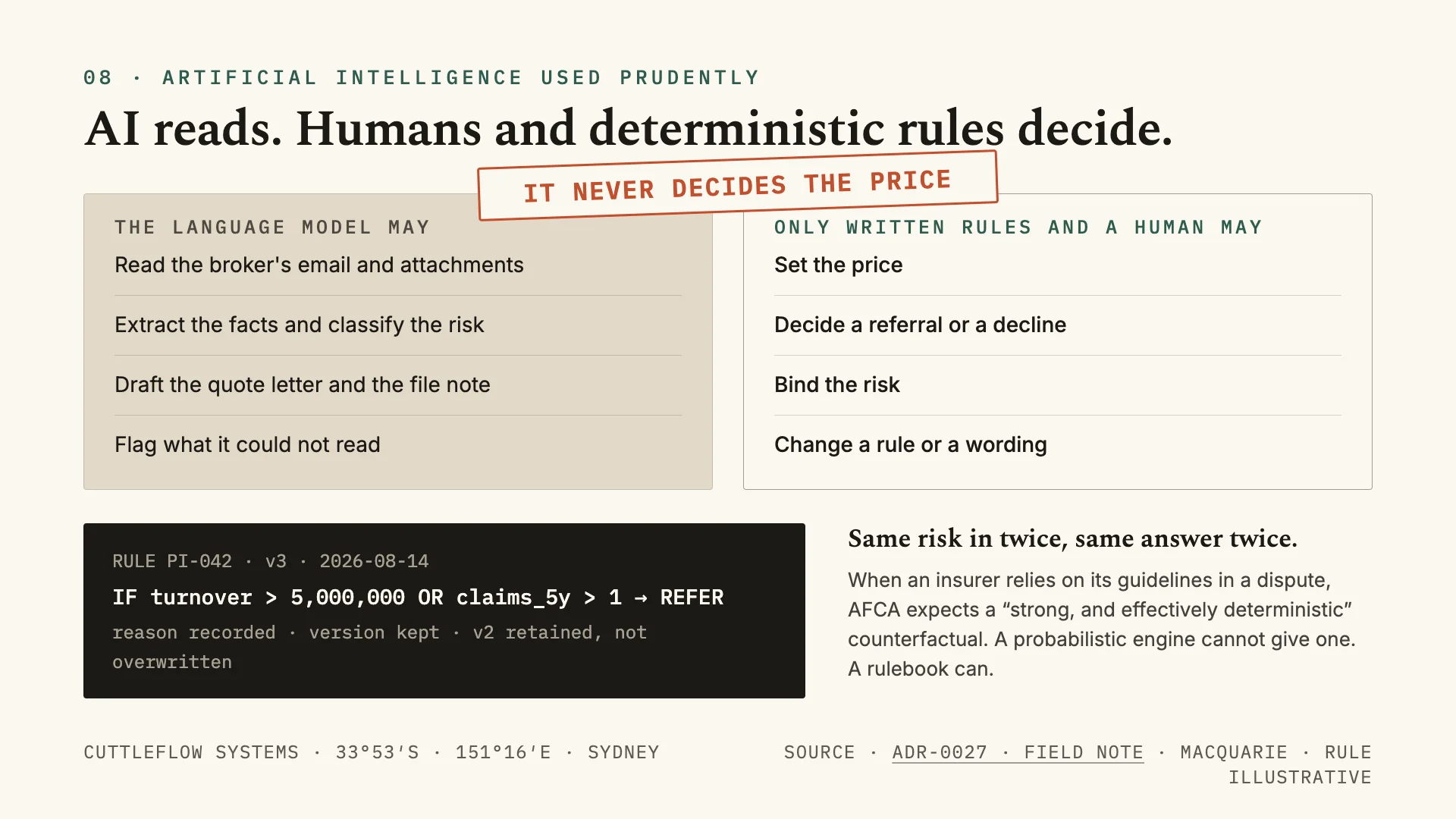
Slide: two lists — what the language model may do (read the broker’s email and attachments, extract the facts and classify the risk, draft the quote letter and file note, flag what it could not read) and what only written rules and a human may do (set the price, decide a referral or a decline, bind the risk, change a rule or a wording) — stamped ‘It never decides the price’. An illustrative versioned rule, PI-042 v3, and the note that AFCA expects a strong and effectively deterministic counterfactual.

Slide 9 of 14 · Step 08 · What we refused

AI reads. Humans and deterministic rules decide.

Open in the deck ↗

One thing we refused to build — and for capacity providers and anyone who answers to the regulator, this is the most important slide. AI reads. Humans and deterministic rules decide. The language model reads the broker's email, extracts the facts, classifies the risk and drafts. Then it stops. The price, the referral, the decline and the bind come from written rules: readable, versioned, and corrected by adding to the record rather than writing over it. Nothing on the decision path is a language model. It never decides the price. That matters because the same risk submitted twice must get the same answer twice. An auditor needs that. A capacity provider needs it when they review your binder. And when an insurer relies on its guidelines in a dispute, AFCA expects a “strong and effectively deterministic” counterfactual — a rulebook can give one; a probabilistic engine cannot. Two things software does not move: a licence and a line. Cuttleflow is neither. What a system can do is make the record prove itself, so a capacity provider sees a three-person firm as clearly as a three-hundred-person one.

Sources · Field note — Why we never let the AI set the price (ADR-0027) · Rule shown is illustrative

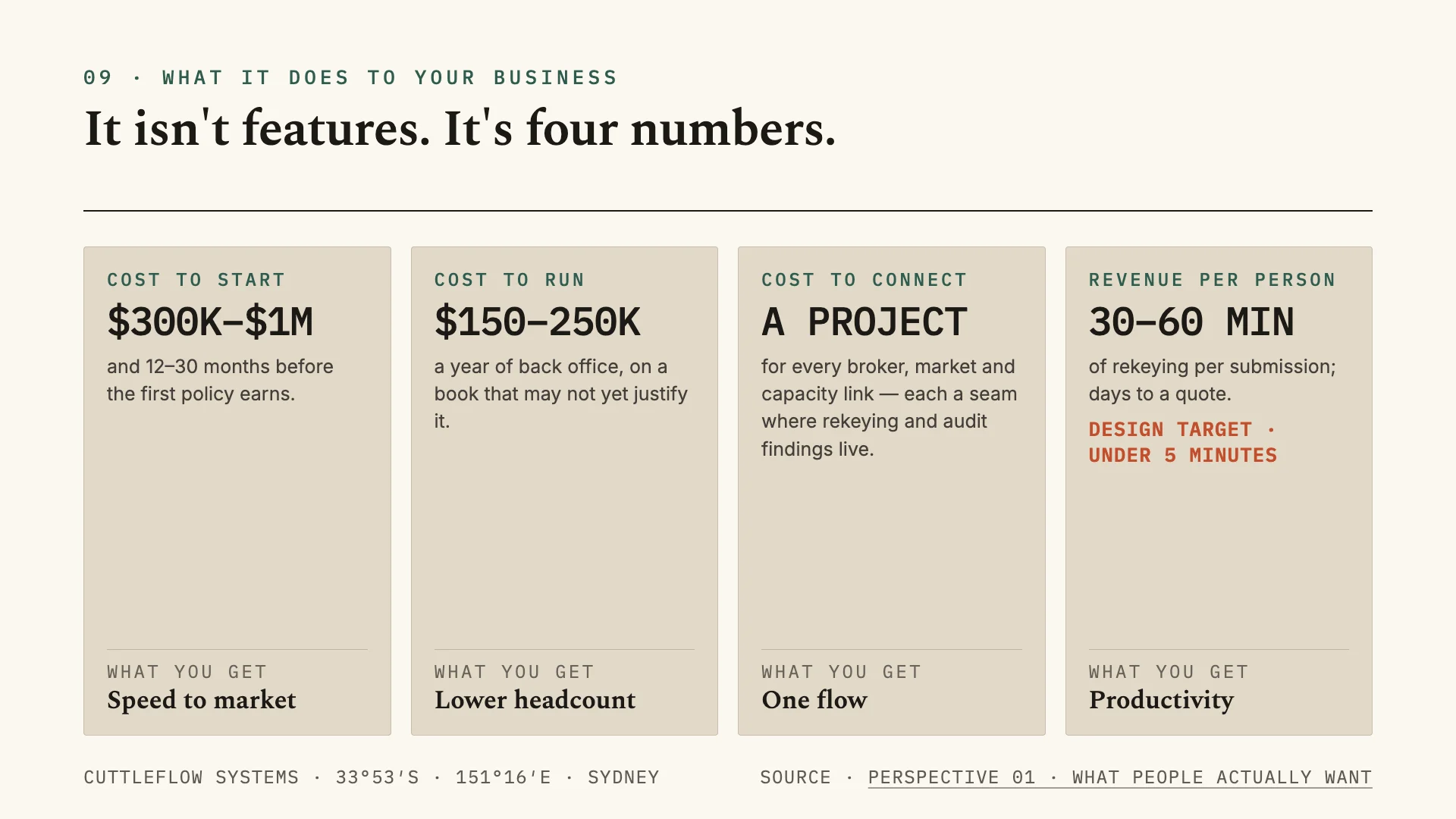
Slide: four cards — cost to start ($300K–$1M and 12–30 months; what you get: speed to market), cost to run ($150–250K a year of back office; what you get: lower headcount), cost to connect (a project for every broker, market and capacity link; what you get: one flow) and revenue per person (30–60 minutes of rekeying per submission, design target under 5 minutes; what you get: productivity).

Slide 10 of 14 · Step 09 · Four numbers

It isn't features. It's four numbers.

Open in the deck ↗

Nobody in this room buys features. You run a P&L, so here it is in four numbers. Cost to start: the year I described. It should not be a year, and it should not be a capital project. Cost to run: $150,000 to $250,000 a year of back office on a book that may not yet justify it. It should scale with the book. Cost to connect: every link to a broker, a market or a capacity provider has been priced like a project, and each one is a seam where the rekeying and the audit findings live. Revenue per person: thirty to sixty minutes of rekeying on every submission and days to a quote — the target we designed to is under five minutes. Move those four numbers and you get speed, which brokers price by the minute; certainty, which capacity prices into your binder terms; time back, the only thing that gets you past quoting; and one flow. There is a fifth number, and software alone does not move it: capacity. It is a ceiling, not a cost. What a system can do is make it cheaper for the person above that ceiling to see your book — which turns a ceiling into something you can negotiate.

Sources · Perspective 01 — What people actually want

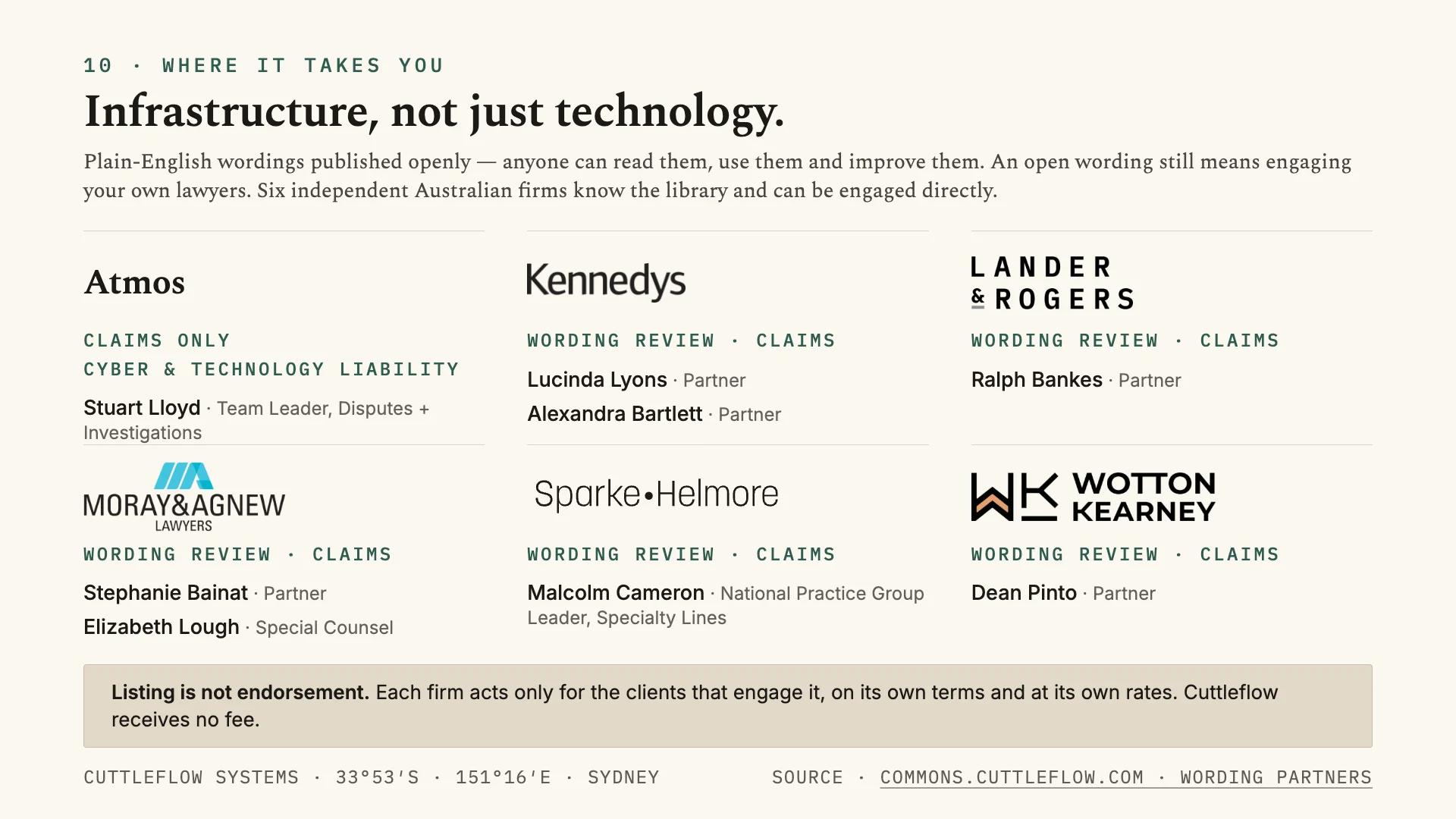
Slide: six independent Australian law firms that know the Cuttleflow Commons wording library — Atmos (claims only, cyber and technology liability), Kennedys, Lander & Rogers, Moray & Agnew, Sparke Helmore and Wotton Kearney (wording review and claims) — with named contacts, and the note that listing is not endorsement and Cuttleflow receives no fee.

Slide 11 of 14 · Step 10 · Wording partners

Infrastructure, not just technology.

Open in the deck ↗

This is infrastructure, not just technology. The wordings behind those twenty classes are published openly, in plain English, and an open wording still means engaging your own lawyers — to review it against your appetite and capacity terms, endorse it for your book, and act when a claim comes in. Six independent Australian firms know the Commons library and can be engaged directly.

Sources · Cuttleflow Commons — wording partners

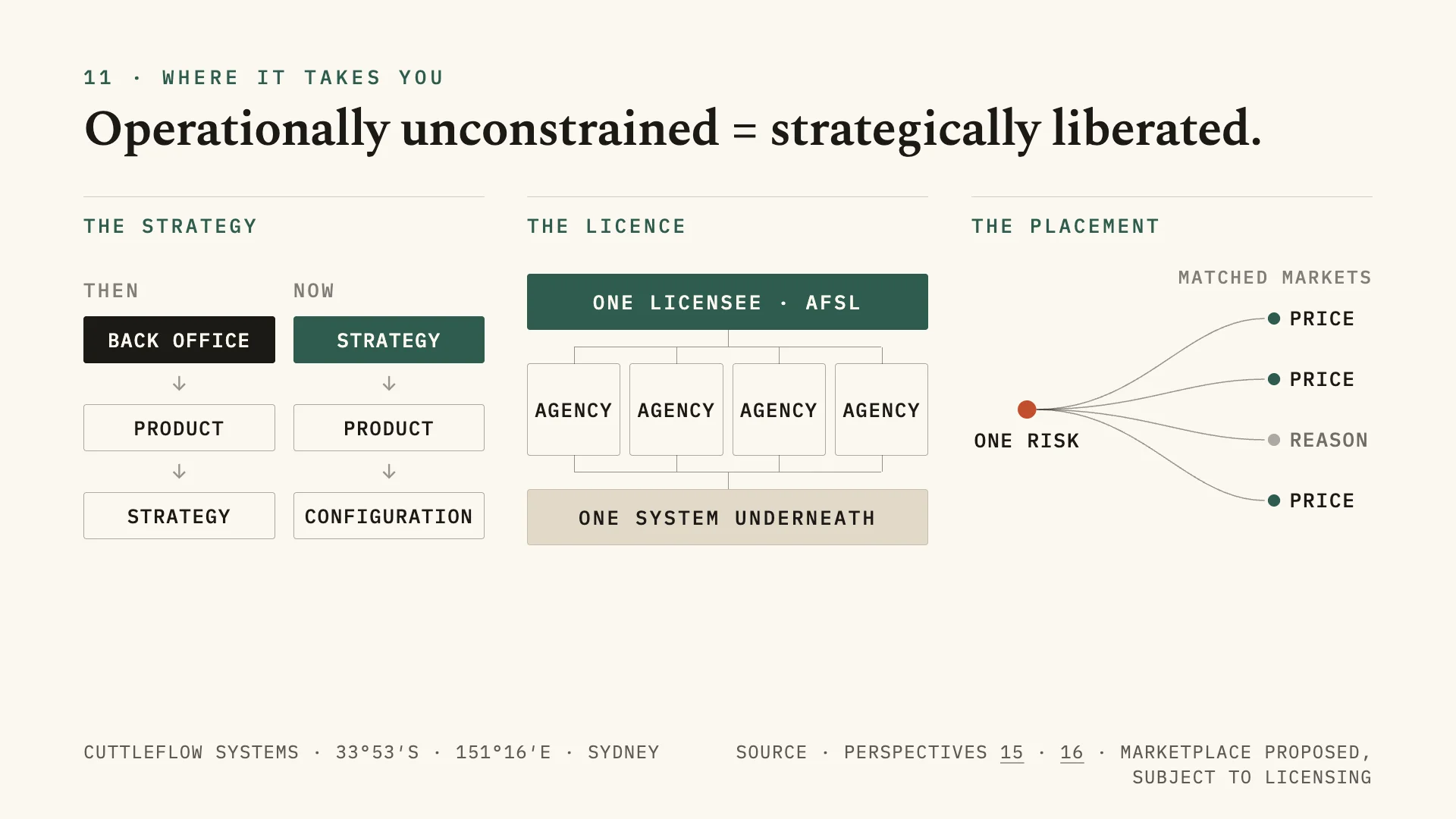
Slide in three panels. The strategy: then, back office → product → strategy; now, strategy → product → configuration. The licence: one licensee (AFSL) above four agencies, with one system underneath. The placement: one risk sent to matched markets, returning a price, a price, a reason and a price.

Slide 12 of 14 · Step 11 · Operationally unconstrained

Operationally unconstrained = strategically liberated.

Open in the deck ↗

So what happens when you solve an agency's operations? It means you can rethink everything about the business. For example:

The strategy. Ask an agency why it writes what it writes and you get a history, not a strategy — the founder's class, the one capacity provider who said yes, the one product the first system could handle. The back office chose the position. When a product is configuration, that reverses: you can put your strategy first and decide which products to sell, in what combination. For example, packages or bundles for particular industries, or automatic cross-sell opportunities.

The licence. Broking solved this thirty years ago with the authorised representative — one licensee, many businesses. Underwriting is getting the same structure, and what matters most is what sits underneath: one system, so authority is enforced at every bind, supervision is by observation rather than sampling, and a book can move as a change of authority rather than a migration.

The placement. The Marketplace is a proposed venue. The idea is simple: open a broker portal so brokers can get multiple quotes on the same product from coverholders on the platform. Cuttleflow can thereby provide deal flow to our clients.

Sources · Perspective 15 — Operationally unconstrained · Perspective 16 — The authorised representative · Marketplace: proposed, subject to licensing
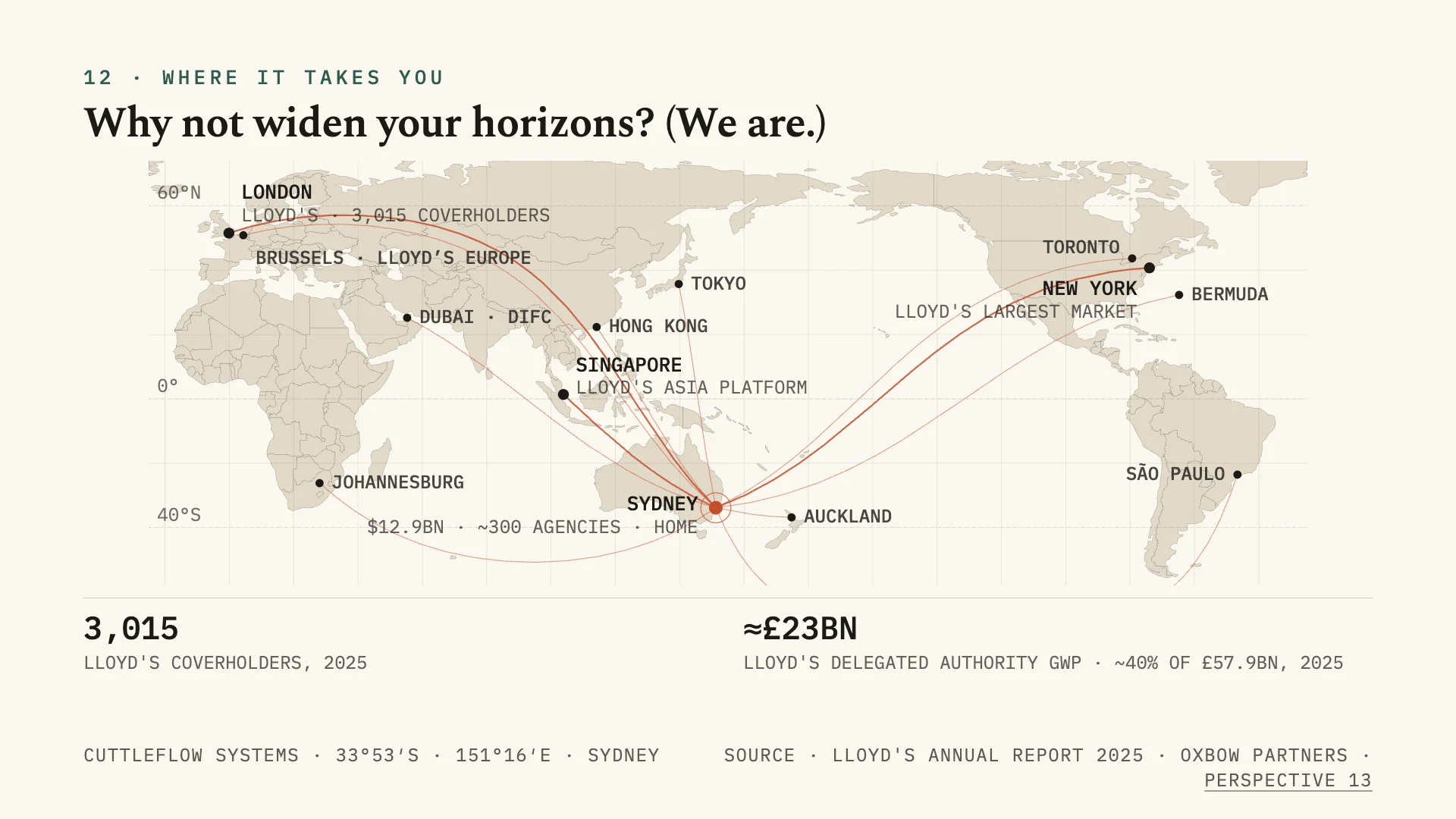
Slide: a world map with Sydney at the centre — $12.9bn, around 300 agencies, home — connected to London (Lloyd’s, 3,015 coverholders), New York, Singapore, Brussels, Toronto, Bermuda, São Paulo, Johannesburg, Dubai, Hong Kong, Tokyo and Auckland. 3,015 Lloyd’s coverholders in 2025; about £23bn of Lloyd’s delegated-authority premium, roughly 40% of £57.9bn.

Slide 13 of 14 · Step 12 · World markets

Why not widen your horizons? (We are.)

Open in the deck ↗

The last piece of scope is geographic. Delegated authority is written all over the world. Lloyd's alone stands behind more than 3,000 coverholders, and about 40 per cent of its premium — roughly £23 billion — comes through delegated authority. A licence is granted per jurisdiction, and it always will be. The system does not care where the risk is: the same record, the same rules and the same audit trail, wherever the licence lets you write. If your ambition is one class in one state, this will run it. If your ambition is to take on the world, it is the platform for that business too. The constraint stops being the back office.

Sources · Lloyd's Annual Report 2025 · Oxbow Partners · Basis in Perspective 13

Closing slide on a dark ground: ‘Nobody designed it, nobody funds it, and nobody calls it a programme — but the Australian agency market has produced more financial-services founders than any incubator in the country.’ Systems for underwriters, built by underwriters. 10 September 2026.

Slide 14 of 14 · Close

The Australian agency market has produced more financial-services founders than any incubator in the country.

Open in the deck ↗

Let me finish with something about this market that I think is true and that nobody says. Nobody designed it, nobody funds it, and nobody calls it a programme — but the Australian agency market has produced more financial-services founders than any incubator in the country. Almost every one of those 300 agencies started the same way: an underwriter, an appetite, and a binder. For most of that time, the year of plumbing was the price of entry, and it kept the best underwriters inside big institutions. That price has gone. Most agencies are still at the stage of quoting. Now they do not have to be. We built the system we wished had existed when we started. Systems for underwriters, built by underwriters. Thank you — I am happy to take questions.

“The cost of starting has always been the tax on underwriting entrepreneurship. What changed is that the tax is now largely optional.”
Perspective 12, The pen is portable

“One of the most productive founder pipelines in Australian financial services ran itself, unnamed, because specialisation pays.”
Perspective 13, The market that wants founders

Sources · Perspective 12 — The pen is portable · Perspective 13 — The market that wants founders

Sources and further reading

Every figure on a slide is cited on the slide. The papers below are where the argument is made at length; market figures are set out with their sources in Perspective 13.

Perspective 01 — What people actually want

Four numbers: cost to start, cost to run, cost to connect, revenue per person.

Perspective 03 — Written once

The economics of straight-through processing; the back office verifies the close instead of producing it.

Perspective 08 — The end of small

Every advantage that made a large insurer large was a fixed cost; a fixed cost that becomes rentable stops being an advantage.

Perspective 10 — Six speeds, one clock

Speed to quote is the first of six, and five of them are decided at bind.

Perspective 12 — The pen is portable

The arithmetic of leaving a corporate seat, on stated illustrative assumptions.

Perspective 13 — The market that wants founders

The market figures behind slides 2 and 13 — Macquarie, UAC, Lloyd’s — with sources and basis.

Perspective 14 — The arithmetic of legacy

Interfaces grow with the square of the estate; why the incumbent cannot simply rebuild.

Perspective 15 — Operationally unconstrained = strategically liberated

When a product is configuration, the shape of an agency becomes a decision rather than an accident.

Perspective 16 — The authorised representative, turned toward underwriting

The three models, the five conditions an equity network has to meet, and why one system underneath makes supervision work.

Field note — Why we never let the AI set the price

The AI reads, researches and drafts; every price and every decision comes from written, numbered rules and from people holding written authority.

Getting to market

What a new agency or coverholder needs before it can write, and the four diligence questions capacity asks.

The platform

Typed products, deterministic rules, the immutable ledger and the monthly close.

Cuttleflow Commons

The open wording library and the independent firms that work with it.

On the claims made. Statements about how the system works are design claims — how Cuttleflow is built to work — and the website states what is available and when. Cuttleflow provides neither a licence nor capacity. The Marketplace is a proposed venue; it is not operating, and Cuttleflow Pty Ltd does not hold an AFSL. The wording-partner listing is not an endorsement: no firm has reviewed or signed off a Commons draft unless a review letter from that firm says so. Cost and time figures are illustrative ranges drawn from the sources cited; the rule shown on slide 9 is illustrative.

Cuttleflow Systems · Launch deck · 33°53′S · 151°16′E · Sydney